
A few months ago the U.S Capitol was breached as a mob stormed the building. January 6 has etched itself into U.S. history in the same way 9/11 has; if you mention the date people know exactly what day and event you are talking about, without any reference to the year or what might have transpired on that day. People already know exactly what you’re referring to.
A lot has been revealed in the past few months about how this day was planned and how its planning was ignored by intelligence and security, and that the intelligence and security apparatus that requested assistance to prevent and stop the breach was ignored or ordered down. We know a lot about of what motivated people to show up that day at the rally that was intended to be violent, and a lot about their personal history.

We can’t be surprised that this day happened, and not because people were openly planning it on social media. Shortly after the economy collapsed in 2008 the Tea Party movement began. Not a political party by nature, but more of a conservative populist movement, the Tea Party advocated for massive reduction in the size of government and used methods ranging from protests to political candidates. Although no candidate runs under the Tea Party on the ballot, a significant portion of the Republican caucus in government likely adheres to its ultra-conservative standards and a lot of the conservative electorate moved farther right because of it. It’s not a conservative movement, but more of an anti-government movement.
This is not to suggest that the people who stormed the U.S. Capitol were adherents to Tea Party. But the Tea Party – which took the Republican Party farther right – that advocates for a small government combined with libertarianism, right-wing populism, and anti-elitism is representative of the groups that led the mob. The elected elites simply had no right to sit in the U.S. Capitol affirming the results of an election.
Happy Easter/Ēostre!

Most languages use Aramaic to describe Jesus’s resurrection. Why is English different? Meet the ‘woman’ to blame
Source: The pagan goddess behind the holiday of ‘Easter’
… “Ēostre is variously depicted by scholars as a fertility goddess and a goddess of dawn and light. The dawn connection could explain a linguistic link between Ēostre and the word ‘east.'” …
The best part of my dismal newspaper is probably Sudoku, Work Scramble, or the Funnies. This year for my birthday my parents got me the day calendar of 365 days of Pearls Before Swine. On the back of the comics are daily tidbits. Today’s facts of the day read thus:
- In 1945, U.S. military forces declared the island of Iwo Jima secure after twenty-five days of fighting.
- In 1968, U.S. Army soldiers massacred more than 300 civilians in My Lai in South Vietnam.
- In 1988 Lt. Col. Oliver North and U.S. Vice Adm. John Poindexter were indicted on charges of conspiracy during the Iran-Contra affair.
- In 1998 mass trials began in Rwanda for roughly 125,000 suspected perpetrators of the country’s 1994 genocide.
On this day of war and intrigue what the calendar doesn’t mention was the death of Rachel Corrie. Eighteen year ago today Rachel was crushed to death by a U.S.-made, U.S.-sold Caterpillar (as her dad recently described it) bulldozer, in Gaza while trying to prevent the demolition of a Palestinian house by Israelis forces.

Rachel’s murder by Israel (for which it has denied responsibility) thrust Rachel’s parents into the issue of Gaza. Her death inspired more than her parents; seventeen years later Phillip Weiss of Mondoweiss wrote about the enduring legacy of Rachel, who had inspired a play and is celebrated worldwide – not for dying, but for acting for justice.
When Rachel was killed in 2003 Gaza was merely suffering. It has been under Israeli military occupation since 1967. One of the most densely populated places on the planet, full of refugees, Gaza has been under siege, illegally, by Israel (with the help of Egypt and a blessing as well as help from the United States) for fourteen years. During those fourteen years it has been invaded (war is the wrong word; war is two sided) by Israel three times, plus daily incursions of Israeli military forces that detain people – including children – without charge, and determine whether a Palestinian farmer can farm his land, or a fisher fish.
Gaza has not been immune to the world-wide effect of the corona-virus. As a densely populated place under siege this is challenging; in addition, Palestinians mainly do not have access to a vaccine, despite Israel being one of the highest-vaccinated populations in the world, and Israel’s requirement under international law to provide for the health of Gazans, including the provision of a vaccine. Two months ago even the New York Times was accusing Israel of medical apartheid against Palestinians.
The Rachel Corrie Foundation for Peace and Justice, which Rachel’s parents began after her death (I volunteer for the Foundation), hosted an excellent webinar today about medical apartheid and the current situation in Gaza. The important takeaway is that the U.S. supports the occupation of Gaza, and that local actions, from community-building to contacting our representatives, is essential to ending the oppression of people.
Every day Gazans are fighting for the right to exist, a right that Israel tries to deny them. At times the treatment of Palestinians has been labeled a slow genocide. At times, such as during the fifty day Operation Protective Edge in 2014, Israelis have massacred the people of Gaza. Recently, the International Criminal Court (ICC) has ruled it has jurisdiction to prosecute both Israelis and members of Hamas for war crimes during 2014, despite the protestation of Netanyahu in Israel and Biden in the U.S. It’s as if the fighting of 1945, the massacre in Vietnam in 1968, and the human rights violations of Rwanda are replaying themselves in history. And, of course, Iran is still and issue – or perhaps a red herring. Meanwhile, Rachel Corrie is dead but her ideas of justice and of what is right has not and will not die. Her legacy, her words, and her work will live, while the violence will disappear into footnotes of history.
In the Israeli settlement of Havat Gilad, west of Nablus, Rabbi Raziel Shevach was murdered on January 9, 2018. A month later, in the early morning of February 3, Israeli Defense Forces soldiers in the village of Burkin – near Jenin – burst into the house of elementary school teacher Mabruk Jarrar. At around 4am, thirty-nine year old Jarrar told Gideon Levy, the family was awakened by an explosion that came from the direction of the front door. The family was awoken to find IDF vehicles outside; about twenty soldiers entered the house, said Jarrar, along with a dog from the army’s canine unit that ravaged Jarrar for several minutes. After the soldiers ripped Markruk’s clothes – apparently to get the dog off of him – a solider punched Mabruk in the face twice. Handcuffed, Mabruk was taken to the detention facility at Salem, near Jenin he said. For hours he received no medical attention. Jarrar was arrested for reasons he didn’t know and spent two weeks in the hospital, chained and handcuffed to his bed.
Mabruk’s wife, thirty-seven year old Innas, was prevented by the soldiers for tending to Mabruk while in the hospital. Both in the second marriages, they had been married for about a month before Israeli soldiers burst into their house. Mabruk’s two children, he told Levy, were both traumatized by what they witnessed. Mabruk’s two brothers, , Mustafa and Mubarak Jarrar, were also arrested that night. Mubarak was released; Mustafa remains in custody, reported Gideon Levy on February 16.[1]
A few days later, on February 8, Innas said, at around 3:30 in the morning twenty soldiers showed up again. They ignored her pleas to stop stepping on the bed. They asked her where Mabruk was – apparently unaware he was in army custody at the hospital. “They told her there was Hamas money in the house and that they had come to confiscate it,” Levy reported. In search of the money – or other reasons – a female soldier “took the three women – Jarrar’s wife, his 75-year-old mother and his 50-year-old disabled sister – into a room and ordered them to undress completely.” The search turned up no Hamas money.
Innas said that she received permission from these raiding soldiers to visit in Afula. She was told he was in prison there; he was not. Innas reached out to B’Tselem where a “kind redeemer” found that Mabruk was in the hospital in Afula, not the prison. She was allowed to visit for forty-five minutes.
Gideon Levy reported that Ha’Aretz reached out to the IDF for comment about the treatment of Mabruk. The spokesperson said
On February 3, 2017, security forces came to the village of Burkin, to the house of Mabruk Jarrar, who is suspected of activities that endanger security in Judea and Samaria. Once they were at his home, the troops called him to come outside. After repeated calls and after he did not come out, the forces acted according to procedure and a dog was sent to search for people inside. The suspect had locked himself in a room on the upper floor of the building together with female members of his family.
“When the door opened, the dog bit the suspect, injuring him. He received immediate assistance from the army’s medical forces until he was evacuated to the hospital. Thereafter other activities were conducted in search of wanted individuals. We stress that in contrast with what is claimed in the article, the women of the house were not stripped by army forces.[2]
What the Israeli army said should be taken with a grain of salt.
Also on February 3, Gideon Levy reported in the same article, a similar incident occurred, involving different IDF forces, in the village of Al-Kfir, near Jenin. At around 4am Israeli soldiers “broke into the home of Samr and Nour Adin Awad”. An army dog was brought into the bedroom; it both and wounded Samr and Nour, the parents of four children. Nour told a field researcher from B’Tselem
I held my 2-year-old son Karem, who was crying, to my chest. I opened the door, which the soldiers were banging on, and a dog attacked me, jumping on my chest. Karem fell from my arms. Later I saw that my husband picked him up from the floor. I tried to push the dog away after it bit me in the chest. I managed to move it away but then it grabbed my left hip [with its teeth]. I managed with all my strength to push him away. At that moment, the soldiers looked at the dog, but did nothing. During this whole time my husband was begging the soldiers to release the dog from me. One soldier spoke to the dog in Hebrew and then it grabbed me by the left arm [holding me] for a few minutes, until a soldier arrived from outside the house and removed it. I was bleeding and in great pain.[3]
Ahmad Ismail Jarrar and his cousin Ahmad Nasser Jarrar – were killed by Israeli soldiers on 17 January and 6 February respectively by the Israeli army for the death of Rabbi Shevach. Although Gideon Levy leaves the impression that Mabruk is not related to either Ahmad, Maureen Murphy quotes the rights group al-haq as saying ‘Israel orchestrated a series of attacks against the extended family members of the Jarrar family and the broader communities of Jenin and Nablus.’. Beyond the strip-searching of Innas and her dwelling, al-haq says that the collective punishment included ‘widespread movement restrictions, punitive house demolitions, attacks using police dogs, arrests, indiscriminate killings and the retention of the bodies of the deceased.’ Ahmad Samir Abu Ubeid, was killed by Israeli soldiers during confrontations that erupted when Israeli occupation forces raided a village in search of Ahmad Nasser Jarrar, Murphy reported.[4]

Palestinians inspect the site where Israeli forces killed Ahmad Nasser Jarrar in Yamoun village in the northern occupied West Bank on 6 February (Ayman Ameen APA images) – found at
https://electronicintifada.net/blogs/maureen-clare-murphy/israeli-troops-force-woman-down-syndrome-strip
The story doesn’t begin or end here. Shevach and some of the Jarrar family are dead but their stories is a broader story of military occupation, international law, oppression, and retribution.
[1]Gideon Levy and Alex Levac Feb 16, 2018 1:52 AM https://www.haaretz.com/israel-news/.premium-palestinian-schoolteacher-mauled-by-idf-dog-as-soldiers-watch-1.5824682 accessed 2/25/18
[2] Gideon Levy and Alex Levac Feb 16, 2018 1:52 AM https://www.haaretz.com/israel-news/.premium-palestinian-schoolteacher-mauled-by-idf-dog-as-soldiers-watch-1.5824682 accessed 2/25/18
[3] Report and quotes found in Gideon Levy and Alex Levac Feb 16, 2018 1:52 AM https://www.haaretz.com/israel-news/.premium-palestinian-schoolteacher-mauled-by-idf-dog-as-soldiers-watch-1.5824682 accessed 2/25/18
[4] Maureen Clare Murphy 3 March 2018 https://electronicintifada.net/blogs/maureen-clare-murphy/israeli-troops-force-woman-down-syndrome-strip accessed 3/10/18 at times quoting al-haq
The pandemic has offered us opportunities to do things we’d never thought of before. Not only has working from home become a thing but huge conferences that can span the world, rather than just a region or community, have become a thing.
Some organizations already had global reach long before Zoom because a household name. Done right, the reach of virtual technology has now expanded beyond html2 to globally accessible presentations by organizations that focus on injustice on a global scale.
No injustice has more effect on the entire world than climate change. As I heard through the grapevine recently, an elected official pointed out that if don’t fight climate change nothing else matters. One of the best people – also a former elected representative – raising awareness of the actions to fight climate change (the problem doesn’t need to be solved – the solutions already exist, as Greta Thunberg has said), is former Vice President Al Gore.
Through the organization Climate Reality that he founded and runs he usually has trainings in various places worldwide to create leaders in their community to raise awareness about how to combat climate change (I was trained virtually last summer). Last year was the first time Climate Reality organized a virtual training.
Here is where I make a plug to advertise that there’s another free virtual training that Climate Reality is offering, from April 22 — May 2. Acting now, collectively, is essential to address the climate crisis. Don’t look at your schedule and think you can’t do it; last year’s training was live, but it was structured so that everyone in the world could participate, learn, and work together.
The reality is that Climate Reality is a great way to learn to act now to address the climate crisis. Follow the link to sign up.
It is what we choose to know that makes us who we are
We only know what we learn. This was the logical thought I shared last week. It’s concomitant is that we only know what we are willing to learn.
A common refrain, at least for me and likely for many other readers of the online comic xkcd, is that “someone is wrong on the internet“. Some days it seems like everybody thinks everybody else is wrong on the internet. Social media is an easy place to think someone else is wrong, and to tell them so. But we only know what we know and what we are willing to learn.

I can’t speak to what other people are willing to learn. Education people is a tiring task; educating people through social media is a momentous task. I hope we are willing to learn.
Social media should be a place to learn. Many social issues, however, can’t be addressed in Tweets, on a TikTok, or on Facebook – which has mostly become an echoey shoutbox. Instead I’ll use this blog to answer some of the most difficult questions people argue over on social media.
Is Gaza occupied by Israel? Does Israel responsible for Gaza under international law? According to the UN Human Rights Council, Israel has “the obligations … as the occupying Power to ensure the welfare and safety of the Palestinian civilian population under its occupation in the West Bank, including East Jerusalem, and in the Gaza Strip, and noting Israel’s wilful abdication and rejection of its obligations in this regard.” The fact that Israel is not physically occupying Gaza with civilians or the military does not change this fact.
B‘Tselem, an excellent human rights organization in Israel, expands on what the HRC says, adding “Israel cannot evade its legal responsibility to respect the human rights of residents of the Gaza Strip in those areas of life that Israel controls. Even after the disengagement, Israel continues to bear legal responsibility for the consequences of its actions and omissions concerning residents of the Gaza Strip. This responsibility is unrelated to the question of whether Israel continues to be the occupier of the Gaza Strip.”
The question of whether Gaza is occupied and whether Israel is responsible for the the welfare of Gazans actually has as very simple answer. This is not one of yes/no/maybe.
This includes the health of Gazans, who are frequently denied access to Israeli hospitals, have their food rationed by Israel, and are denied access to receiving COVID-19 vaccinations, despite the fact that Israel one of the highest vaccination rates in the world.
None of us are born knowing these facts. The question is whether we are willing to learn. It is not until we know things through learning that we can act to remedy these man-made problems.
We only know what we are taught. My nephew was here recently for several days; I know that’s against COVID recommendations, but I’m not in charge of everything that happens in life. It’s also good, perhaps essential, to both spend time with a relatives as they grow up, and for them to grow up spending time with relatives.
He’s over-smart — if there’s such a thing — for his age (first grade?!?), with a great memory and keen interest in reading (I would quip that it’s easier to remember everything you read and hear when you’re younger), writing, arithmetics, the arts, and sports. And he’s good at all of those pursuits. I told him ping-pong is like baseball: you need to follow through on your shots. That was a mistake!
What he didn’t know, as we were playing ping-pong, is where I learned to play. I asked him one day who he thought taught me how to play. “My dad” (my brother), he guessed? It is true, as I told him, that my brother, who was also visiting, taught me to play baseball. No, I told it, it was my grandma. Nana, who we collected visited as a family – talking to her through the glass at her nursing home – for her 95th birthday, was the one who taught me to play ping-pong. “I know you see her as old and slow” I told my nephew, “but she wasn’t always that way”.
This is not to criticize or reprimand my nephew for not knowing who taught me what. This is a story of what we learn – and perhaps what we don’t – from generation to generation.
My nephew had to return home, of course, which he did by flying with both of my parents. (I remember once flying alone as a seven year old to see relatives who would pick me up at the airport gate. Apparently such a thing is no longer possible). I wasn’t on this venture but there’s a lesson here. My very bright nephew had never heard, apparently, that where he lives there used to be rivers. Rivers flow to the ocean – or they did, until several major rivers were cemented in in Southern California. We only know what we learn.
Is it possible to know things we don’t experience? Yes. In my own recent experience I was in a Zoom meeting. In many meetings working on social justice I am an age outlier – most people have experience protesting the Vietnam War. This time a woman in her twenties or thirties was present, and took the time to thank the other members who lead discussions on nuclear weapons (history, current policy, development, abolishment) for doing what they do.
“My generation doesn’t have the experience of the fear of the Cold War,” she said. So the fear of nuclear weapons is very different. I almost wanted to interject and remind her that the Cold War has never ended – at least, as far as our elected official behave – but I didn’t say anything.
Surely there are people in my generation – who pretty much grew up in the post-9/11 era – who remember the fear of nuclear weapons? I’m going out on a limb here, thinking my parents weren’t the only ones talking about school drills to hide under a desk in case of nuclear attack. The fear of nuclear weapons might have been transferred to the fear of a terrorist attack by the powers that be, but aren’t they about the same fear level?
We only learn what we are given an opportunity to learn. Through reading or listening we have the opportunity to learn from the older generation, while we have the opportunity to share what we know with the younger generation. What we impart from generation to generation is our choice.
This is inspired by a Jeopardy clue. A few weeks ago, after Alex Trebek had died but he was still hosting the program – a period that might be referred to as interhostum – there was a clue about Burton Wheeler, inquiring which film he inspired.
The answer is Mr. Smith Goes to Washington. The immediate question for my phone was, who was Burton Wheeler? A Senator from 1923-1947, Wheeler was from Montana. I must confess I’ve never watched Mr. Smith Goes to Washington, a movie that Wikipedia refers to as one of the greatest movies of all time.
As fascinating as Mr. Smith Goes to Washington is (I assume) what I have to say here involves Burton Wheeler

and the U.S. governmental system (as did Mr. Smith Goes to Washington, although they adapted the story and the names). Doubtless in some way inspiring the movie that takes on a different story, Wheeler might best be known – despite running for Vice President as part of the Progressive Party (Wikipedia) – for his involvement in the Teapot Dome Scandal.
Involvement is actually the wrong word. As part of the Senate Wheeler was part of investigating the scandal. The scandal, which sent a cabinet member to prison for the first time in U.S. history, involved the granting of rights to oil-rich land in a no-bid fashion, and receiving a kickbacks. Albert Bacon Fall, the Secretary of the Interior, who granted the rights to the Mammoth Oil Company and Pan American Petroleum Company, received $200,000 in bonds, and other members of his family profited (I don’t know if $200,000 refers to 1920’s dollars, or current money; it shouldn’t matter.
Despite this abuse of office one might consider the scandal a victory – or not defeat – of democracy. The Supreme Court ruled that the President Harding didn’t have authority to put Albert Fall in charge of the lands and Congress told Harding to cancel the loans.
Whether Fall became a fall guy for the system – the system being the system of bribery in government – or whether the system of bribery is part of governing is to ask us to predict the future. We can look only at the past and present, and decide what future we have.
Doubtless written before the Trump administration took office Wikipedia says that until Watergate Teapot Dome was the biggest scandal in the history of the U.S. As far a bribery and abuse of office for financial gain is concerned that’s probably true.
We now live in the era of Citizens United with an executive branch the flaunts the Emolument Clause. Compounded with the executive branch – and its supporters inside and outside government – continuously reinforcing to the public that bribery and abuse of office is normal, the democracy we envision is in question.
Burton Wheeler was a progressive Democrat from Montana (at a time when the Democrats were associate with Jim Crow views in the South). A supporter of the New Deal Wheeler did not toe the party line, and was an non-interventionist against war – at least until Pearl Harbor.
Beyond the conclusion that bribery and malfeasance is bad, and that our system can prosecute such things, it’s important to note that like in Wheeler’s time ninety years ago, we too have a progressive party and that at no point in U.S. history has there been only two parties. We too can have a elected representative that does not always support the party, and is willing to stand against war. We too can have a system that represents the people and not the corporations.

2020 started off on fire. Literally. The bushfires that burned more than 45 acres in Australia were so destructive of wildlife that koalas and other marsupials may never recover as species. The fires were so destructive they garnished world attention, and reminded people of simple facts like that Australia is about three thousand miles from west to east, similar to the United States.
As fires raged across a continent the most deadly, destructive, and disruptive pandemic since the Spanish Flu began to catch people’s attention. By March COVID-19 was in almost every country; most countries responded by closing down, which led to a situation where “essential workers” still worked and traveled and spread the virus.
At the same time the word began to notice the COVID-19 virus Fiji was hit by a Category Five Hurricane, an article in Nature says (they appear to be referring to Tropical Cyclone Harold).
Between the fires in Australia, Category 5 Hurricanes, and COVID-19 the rest of 2020 should have been obvious to everyone; a degree in seeing-the-future not required. Contrary to what we might hope and believe, 2020 was not an accident, an aberration, or a fluke.
By the time we got to the end of summer in 2020 as COVID-19 continued to affect the economy and society of every country, much of the western states in the U.S. were on fire as California experienced its most destructive fire season on record, Oregon and Washington – also with the most destructive fire season on record – lost entire communities. At the same time, the Amazonian rainforest was on fire – often set by humans – and would remain so for months; in Africa Sudan experienced flooding that displaced 150,000 people; southern France was flooding, and in the U.S. the Gulf States were suffering a hurricane season never seen on record for intensity or frequency. Not long after this, Korea was hit by two cyclones (hurricanes) within a week. Many of the storms that led to hurricanes and the requisite flooding were labeled “unprecedented” or “unheard of”.
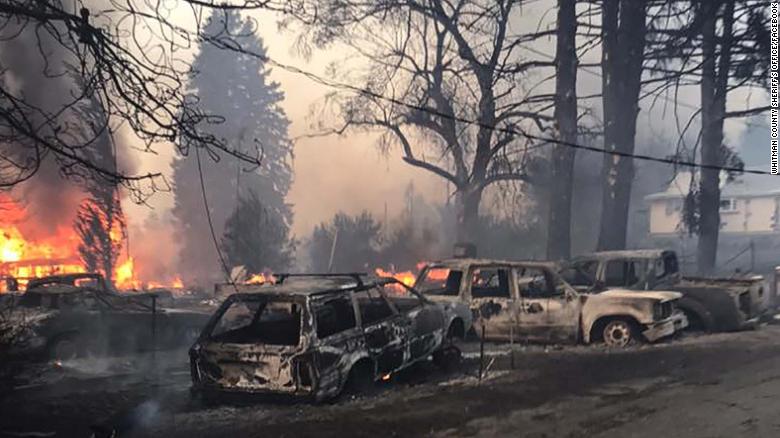

All the storms, as well as the drought that leads to fire conditions, are based on weather patterns. All the storms have been made stronger by climate change. In fact, it’s believed that COVID-19 and other pandemics will increase in frequency, and perhaps in potency, as climate change increases. One of the few advantages that COVID-19 has provided us as a global society is that the pandemic forced people to travel less. This has created less pollution with less vehicles on the road and allowed animals to return to their natural habitat without being disturbed by humans.
Bill Gates suggests that as bad as COVID is in terms of death, disruption to the economy, and it’s global effect, climate change will actually be much worse. One of the best known billionaires in the world, Gates said in August that in real terms, because of COVID, “we will release the equivalent of around 47 billion tons of carbon [into the atmosphere], instead of 51 billion. That’s a meaningful reduction, and we would be in great shape if we could continue that rate of decrease every year. Unfortunately, we can’t.” What’s remarkable, he says, “is not how much emissions will go down because of the pandemic, but how little.” Brilliant with numbers, Gates compares climate change to COVID:
As of last week [in August], more than 600,000 people are known to have died from COVID-19 worldwide. On an annualized basis, that is a death rate of 14 per 100,000 people.
How does that compare to climate change? Within the next 40 years, increases in global temperatures are projected to raise global mortality rates by the same amount—14 deaths per 100,000. By the end of the century, if emissions growth stays high, climate change could be responsible for 73 extra deaths per 100,000 people. In a lower emissions scenario, the death rate drops to 10 per 100,000.
In other words, by 2060, climate change could be just as deadly as COVID-19, and by 2100 it could be five times as deadly.
Gates refers to the end of the century what would happen if emission growth stays high. The reality is that 2020 is projected to be the coolest year (it was hot this year) in the next hundred years, even if we reached net zero carbon use in the next fifteen years. Economically, Gates says, regardless of which model you use, “in the next decade or two, the economic damage caused by climate change will likely be as bad as having a COVID-sized pandemic every ten years. And by the end of the century, it will be much worse if the world remains on its current emissions path.” This article extends beyond Gates’ thoughts, but I would suggest you read his article, which has real suggestions and solutions to mitigating climate change and avoiding climate and economic disaster.
Climate change also has has a great effect on human migration and displacement. Tens of thousands of people were displaced by fire (happening as late as December, in California), hurricanes in the Gulf States, cyclones in Korea and Japan, and flooding in Kenya. Climate change, driven by the emissions of carbon by developed countries, has a disproportionate effect on on poor people, both in “undeveloped” countries and the poor people in developed countries. It’s likely that climate change will alter the cropland of the United States; it’s also well-known that climate change is causing sea rises and will cause frequent flooding for the hundreds of millions of people who live near the coast, or a river.
Contrary to what we might hope and believe, 2020 was not an accident, an aberration, or a fluke. COVID-19 will continue next year, pandemics will increase, the fires and floods that were unprecedented this year will continue to become stronger due to climate change. 2020 has been a hard year for many people with society, and the economy, completely altered by the ongoing pandemic.
The advantage that the pandemic has provided us as, locally and globally, is that we have an opportunity to build a society that is interested in mitigating man-made climate change and thereby preventing the next pandemic, and economic shut-down. We have an opportunity to rethink how we want to live and what we must work if we want to survive as a society.
The solutions exist. The climate crisis does not need to be solved. The lesson is that if we do nothing to prevent climate change, nothing will change and 2020 will be the new normal.

