
Referred to by Terrence Ball and Richard Dagger as one of the leading representatives of classical conservatism in the twentieth century, Michael Oakeshott (1901-1990) suggested that politics must be rooted in tradition and experience, not abstract reason or principles. Oakeshott’s article, “On Being Conservative” was published in Ball and Dagger’s “Ideas And Ideologies: A Reader” (2004), where I first read Oakeshott. “On Being Conservative” can also be found here.
In many ways conservatism, or being conservative, sounds natural. Many of us – probably all of us – have some inclination “to prefer the familiar to the unknown, the prefer to the untried, fact to mystery, the actual to the possible,” the “convenient the perfect,” and other marks of conservationism Oakeshott expressed. Conservatism is the aversion to change, he tells us. More remarkable, that means that “change … appears always, in the first place, as deprivation.” We’re being deprived of the familiar.
Change is inevitable, Oakeshott concedes. The last several centuries have been marked by change. Change naturally happens. It’s just that conservatives “will find small and slow changes more tolerable than large and sudden” changes. Change, after all “is a threat to identity, and every change is an emblem of extinction” of the familiar. A conservative is “strongly disposed to preserve his identity” as he knows it.
This is not to say that innovation is bad. Conservatives – at least conservatives in Oakeshott’s world – know that innovation can be improvement. He says that the conservative temperament will see innovation in a few ways: “innovation entails certain loss and possible gain” and thus the “onus of proof, to show that the proposed change is beneficial may be expected to rest with the would-be innovator”. A conservative would be more likely to go for an innovation that responds to a defect, and this is much more preferred than “one generated by an idea of perfection”; conservatives “prefer small and limited innovations to large and indefinite”; and thus “favours a slow rather than rapid pace” to innovation”; and lastly, “he considers the most favourable occasion for innovation to be when when the projected change is most likely to be limited to what is intended and least likely to be corrupted by undesired and unmanageable consequences.”
Conservatism makes sense in the personal world that Oakeshott discusses, such as maintaining a friendship is inherently progressive. If we extend it to our own habits like food choices , and other habits of being in our ‘comfort zone’ it makes sense.
While all of the above relates to conservatism as a political philosophy, the quotes and habits I’ve commented on are merely one of a conservative person; a person that Oakeshott says is often seen as “rooted in ‘human nature’,” who simply has a “propensity to use and to enjoy what is available rather than to look for something else”. In his concluding section Oakeshott moves on to what these means for “a conservative disposition in politics”. As a non-conservative person I am trying to fathom how conservatives see the world.
This conservative disposition “is nothing to do with a natural law or a providential order, nothing to do with morals or religion”. We can only assume what Oakeshott would think of today’s conservatives in the United States. Our current politicians, including nominees to the Supreme Court, extend conservatism to morals that they themselves don’t follow, and religion that they bastardize for their own use.
Conservative disposition in politics “has nothing to do with morals and religion.” What the disposition is, Oakeshott says, “it is the observation of our current manner of living combined with the belief … that governing is a specific and limited activity, namely the provision and custody of general rules of conduct, which are understood not as imposing substantial activities … “. The government does not exist to “impose other beliefs and activities upon its subjects,” for which we should be thankful for under past, present – and likely – future governments. Nonetheless, “the office of the government is merely to rule”.
There are currently a few representatives in government – and oddly, Oakeshott might find, they tend to be progressive representatives – that would agree with Oakeshott that
it is beyond human experience to suppose that those who rule are endowed with a superior wisdom which discloses to them a better range of beliefs and activities and which gives them the authority to to impose upon their subjects quite a different manner of life.
In addition, they’d probably agree with Oakeshott that the government and its representatives should not be zeroed-in on one issue on which they “spend their energy and wealth,” and spend no energy or wealth on any other issue.
Oakeshott’s conservative government exists to “preserve the peace … not by substantial unanimity, but by enforcing general rules of procedure upon all subjects alike”. As a system, contrary to our current administration and its followers, conservatism is “found in ritual, not in religion or philosophy; in the enjoyment of orderly and peaceable behavior, not in the search for truth or perfection”.
In theory – yes, this is all theory – conservatives approve of innovations, but the modifications should “never on any occasion be so great” as to destroy the equanimity. Conservatives, he makes clear ” will have nothing to do with innovations designed merely hypothetical situations”. It would be best to “delay a modification of the rules until it is clear that the chance of circumstance it is designed to reflect has come to stay a while”. The conservative would be “suspicious of proposals for change”. All this, apparently, while appreciating innovations.
Oakeshott’s conservative, perhaps unlike the contemporary conservatives in the U.S., would be suspicious “of rulers who demand extra-ordinary powers in order to make great changes”; especially, perhaps if those changes are “tied to generalities like ‘the public good’ or ‘social justice’. Despite the reality of a ruler who demands extraordinary powers, the conservative of Oakshott’s world might view policies as thing to be lightly renovated and trimmed from time to time, not severely changed.
Oakeshott recognizes that some politicians want to use the “government as an instrument of passion” and that to inflame the masses is the best course of change. The conservative is certainly against this; the business of a government is “not to inflame passion and give it new objects to feed upon, but to inject into the activity of already too passionate men an ingredient of moderation; to restrain, to pacify, and to reconcile” is the goal of the conservative.
Now I will try to understand conservatism as Oakeshott believes it to be in relation to modern and current U.S. politics. The conservatives – who in theory want to “maintain the peace” through an equilibrium – are in charge of the executive branch, and the Senate. Certainly it’s the Democrats who are more inclined to promote transformative programs of the suspicious notion of ‘social justice’. Programs like the Green New Deal, universal healthcare, and the call to defund the police – which, although it must have a threatening sound to the conservative ear that wants to maintain the status quo, is merely a call to reallocate funding that goes to the police. None of these will happen at the federal level as long as conservatives – anyone interested in not rocking the boat – is in charge of what bills get passed and approved. There is no promise that these changes would happen under a Democratic administration.
Some programs to “maintain the peace” are, or were, programs not limited in scope. For instance, the eighteen-year long war in the Middle East was a blow to the equilibrium of the status quo. So was the response to the immigration crisis, especially at our southern border. The war, and the immigration crisis that has resulted from U.S. policies were drastic changes in behavior and action that has become a norm of the conservative to accept and promote.
Oakeshott certainly believed in the separation of church and state, and thought that no religious outlook would interfere with, or mingle with, the conservative disposition. Remember that he said that conservatism “has nothing to do with morals and religion” and is merely a tempered response to the the reality around us. While the reality is debatable, the classic conservative of Oakeshott’s world responded with a realism not connected to religion or morals to the contemporary world. Extend this thought to a current Supreme Court nominee and you’ll see that Oakeshott’s classic conservative is different from the current conservative.
While conservatives are not inclined toward radical change in policy, this doesn’t imply that liberal Democrats are naturally in favor of drastic change. Also conservative in nature, the contemporary liberal in government is very much a proponent of delaying “a modification of the rules until it is clear that the chance of circumstance it is designed to reflect has come to stay a while”. It appears that the liberal leadership is”suspicious of proposals for change,” even when studies present evidence that the change would be good financially, morally, ethically, and with broad approval. Like the classic conservative, it seems that liberals “will find small and slow changes more tolerable than large and sudden” changes. While small and slow changes occur, there will be no transformative, radical, necessary, changes made by the government of the people, by the people, and for the people.
Seeing that conservatism in both its current form and the form that Oakeshott propounds and that liberalism in its current form is not working to bring about changes necessary changes in policy the logical suggestion would be to think beyond conservatism and liberalism. Even Oakeshott’s conservative knows that change happens and can appreciate it; it’s time for the government to abandon conservatism and bring passionate change of necessary, positive, changes for the people.
Voting for Joe Biden to replace Donald Trump is a bit like voting for Sauron, the fallen wizard, to replace Saruman.
I know that we don’t live in a world with elves and wizards, with both a longevity far greater than Methuselah, and that the dwarfs in our world are not ax-wielding warriors under the mountain, but we do live in a world with good and bad, and bad that turns evil.
No reasonable person would vote for Sauron during the Third Age of Middle Earth. Assuming that all the races of elves, dwarfs, hobbits, and everyone else were casting votes for a leader, and Sarumon the White Wizard was up for election, many people, even the elvish leaders and his fellow wizards would vote for Saruman. But they would be deceived.

We know that Saruman was a respected leader and that his fellow wizards turned to him for answers and insight. Yet he deceived them.
We know that Biden has been a respected personage in government for a long time and that might be turned to for answers and insight. We would be deceived to think that Biden has any more inclination than Saruman did, or to lead us in a more encouraging direction to the future.
Recall that Saruman, while fallen, became a beggar along the road, looking to turn hobbit against hobbit, and interfere with things like the planting of crops, while working to turn the green countryside brown.
I don’t know what the means to the fact that we are deceived to think that Biden (Saruman) is a great choice to be elected, just because he is running against Trump (Sauron). I do know that electing a fallen wizard to replace the sleepless eye of Mordor is not an encouraging option. We could do better, of course, and elect Radagast or Tom Bombadil.
An article from ten years ago remains quite accurate. Once again people are pushing from what they – wrongly – perceive to be centrism.

I write a lot about politics. In my world-view, that’s frequently the topic to write about on this blog over social commentary. Most topics begin with or return to politics, and so it’s not a surprise. I’m not sorry, exactly, that politics is frequently the topic; it is my life, and, as I say, most things begin with or return to politics. I don’t mean to write about politics exclusively, but once again, here I go writing about politics.
I get to talk to a lot of you, my friends. Some of you see me as the political Buddha; I often advocate patience and calmness and reason. And once again, I’m talking about patience and political moderation, although my desire is that things improve much more quickly than what I advocate as reasonable and likely.
In September, 2010, 34.6% of adults were Democrats, and 33.1% were Republicans, according to Rasmussen…
View original post 398 more words
Brothers and Sisters, “Green peace is beautiful! And you are beautiful, because you are here tonight! You came here because you are not on a death trip! You believe in life, you believe in peace, and you want them now!”
The Vancouver Sun ,of Canada, reports that those were the words of Irving Stowe, an American expat who helped found Greenpeace, at the concert held fifty years ago that launched Greenpeace.
The concert, attended by 10,000 people, had Phil Ochs, Chilliwack, James Taylor and Joni Mitchell performing to the outrageous price of $3 a ticket.

Effective October 16, 2002, the 107th Congress passed the Joint Resolution to authorize the use of United States Armed Forces against Iraq. Signed by George W. Bush on that day the act has remained in force – pun intended – for the last eighteen years with Congress repeatedly updating and approving what has been called the Iraq Resolution.
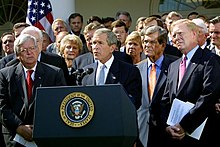
An authorization of use of military force (AUMF) is meant to provide temporary, limited, ability to conduct war. This differs from a complete, or total war; the war is meant to limited in scope. Clearly, the length of a limited war (oops, authorization of force) differs; and article posted recently by Heather Brandon-Smith of the Friends’ Committee on National Legislation reminds us that since the U.S declared war on Romania in 1942 during WWII, “the wars in Vietnam, the Persian Gulf, Afghanistan, and Iraq have all been authorized by AUMFs.”
There have been efforts to repeal the 2002 authorization of use of military force, including efforts during the present, 116th, Congress. And article by Tess Bridgeman of Just Security, coordinated by the Reiss Center on Law and Security at the NY School of Law, reports that an amendment by Barbara Lee to the Fiscal Year 2020 National Defense Authorization Act (NDAA) would entirely repeal the AUMF.
The 2002 AUMF is not needed, Bridgeman says.
Unlike the 2001 AUMF, the United States is not solely relying on the 2002 AUMF for any ongoing military operations. While the Obama and Trump administrations have included the 2002 AUMF as an alternate or additional basis to support operations against ISIS in Iraq and Syria, the executive branch is primarily relying on a different force authorization, the 2001 AUMF, to fight ISIS. And the 2001 AUMF would be sufficient to authorize those operations in the view of the executive branch.
Things just got complicated. There is in fact a 2001 Authorization of Use of Military Force Act. Bridgeman of Just Security tells us “the 2001 AUMF has served as the source of domestic legal authority for an ever-expanding set of operations against al-Qaeda, the Taliban, their ‘associated forces’ (like AQAP in Yemen and al-Shabaab in Somalia), and most recently ISIS”. Or, as the article by Friends’ Committee on National Legislation puts it,
the 2001 AUMF authorized force against all who ‘planned, authorized, committed, or aided the terrorist attacks that occurred on September 11, 2001, or harbored such organizations or persons.’ It is often referred to as the blank check‘ for endless war.
The purpose of the 2002 AUMF, again according to the Bridgeman at Reiss Center on Law and Security, was to remove Saddam Hussein. The AUMF has no longer has a purpose. She add that the 2002 AUMF was rarely invoked, and even when Obama invoked it in 2014, the administration said the 2002 AUMF should be later repealed. Nonetheless, the 2002 AUMF has been used by “to justify 41 operations in 19 countries by claiming that the 2001 AUMF applies to ‘associated forces’ of al Qaeda and the Taliban;” a term that appears “nowhere in the law” Brandon-Smith points out.
Although the 2002 AUMF “wasn’t intended to be, and shouldn’t be read as, a permanently available force authorization to address any threat that might relate to Iraq, recent events have given reason to fear the executive branch could use it that way,” Bridgeman added. Daesh, commonly known as ISIS, didn’t exist when the 2002 AUMF was approved, and although it goes beyond the scope of the bill the 2002 law has been used to fight ISIS, and some worry that the law could be invoked for a war against Iran.
Barbara Lee’s amendment to the 2020 National Defense Authorization Act, which called for the repeal of the 2002 AUMF has broad support. The Friends’ Committee on National Legislation says that “more than 130 members of Congress have cosponsored Rep. Lee’s stand-alone bill to repeal the 2002 Iraq AUMF, H.R. 2456”. Further, a bill in the Senate, In the Senate, S.J. Res. 13 from Sens. Tim Kaine (VA) and Todd Young (IN) “would repeal both the 2002 Iraq AUMF and the 1991 Gulf War AUMF, passed to authorize a military response to Saddam Hussein’s invasion of Kuwait.”
I would go beyond an important amendment, which calls for the repeal of the use of force act of 2002, to the NDAA. There’s also no reason to have in force the 2001 AUMF, which was propelled into existence by September 11, 2001. The 2002 AUMF was inspired by the false claims that Hussein has weapons of mass destruction. We can no longer remember or justify why we have a limited authorization of use of force in Iraq – which has been justified for other “limited” operations. The correct course of action is to repeal and end all authorization of use of force.
This is a story about a lack of justice that falls under the category of “on this day”. If it weren’t for being “on t his day” in history, I’m afraid, I would know nothing of this story.
This is a story about Alex Odeh, who was born in Jifna, Palestine, (not far north of Jerusalem and Ramallah) in 1944. For reasons that only tangentially impact the story, Alex immigrated to the U.S. in 1972.

The American-Arab Anti-Discrimination Committee (ADC), which made me aware of Alex Odeh, says he joined the ADC in 1982. In 1985 Mr. Odeh was in Santa Fe, California on behalf of the ADC, here’s where “on this day” becomes another part of history.
Arriving to the ADC office on October 11, 1985, “Odeh was assassinated when a pipe bomb exploded as he opened the door” the ADC says. The ADC article remembering Odeh confirms that “the FBI classified the bombing as an act of domestic terrorism and designated the investigation as one of the highest national priority. However, despite solid leads, as well as advancements in technology and forensics that could aid in the investigation and prosecution of the perpetrators, no arrest has been made.”
Why Odeh? Why was Odeh assassinated?
The ADC says that “the FBI identified members of the Jewish Defense League (JDL)” as suspects, although no arrests were made in the case. The JDL, in theory, killed Odeh because on the previous day a hijacking of a plane – which the JDL blamed on the Palestinian Liberation Front – involved the death of a Jewish American.
The short answer is that Odeh was killed for advocating for Palestinian rights.
Referring to an article by David Sheen in The Intercept, the ADC says that “two of the prime suspects currently live in settlements in the Occupied Territories in the West Bank. Another suspect is in American prison after being extradited from Israel on mail bombing charges, will likely have his parole end soon and escape justice for the death of Odeh by returning to Israel.
Although the an eye for an eye makes the world blind it’s amazingly disappointing that no one has been prosecuted for the the death of Odeh when the FBI know who the suspects are, and that the reason no one will ever face prosecution is because Odeh was advocating for Palestinian rights.
A planned motorway extension through the Dannenröder forest, north of Frankfurt in Germany, “pits the autobahn against 250-year-old oak trees” in the British words Phillip Oltermann of The Guardian. The Germany government, which has claimed to be a leading force in climate justice in Europe is looking to chop down the trees – a natural and essential defense against climate change – to expand “dual carriageway” A49.
Carola Rackete, a prominent activist and member of the German refugee rescue organization Sea-Watch, who has joined the protests, said on Twitter that the German government is in one breath promising biodiversity and in the next chopping down old-growth forests.
For the last year activists – that is, people who are acting because they believe that the environment is important – have occupied the forests and have built “barricades, treehouses and makeshift platforms,” which the police destroyed this week, as loggers began destroying the forest.
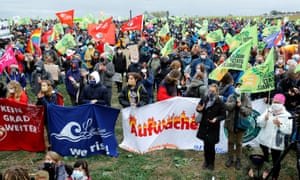
Although masked activists stated things such as ‘we have sadly failed to stop the clearing, because there were too few of us,’ Oltermann says that protests have increased since Friday – that is is, within about the last 72 hours – “with activists temporarily occupying the Hessian state representation’s offices in Berlin on Friday, and about 300 cyclists closing down a section of the south-bound lane of the A49 on Saturday.”
The expansion of A49, Oltermann continues, is not expected to begin until September 2021, and police are expecting ‘long-term resistance’ against the “infrastructure project”.
This is not the first “infrastructure project” that some of the same protesters have engaged in. Oltermann adds that “some of those protesting against the felling at Dannenröder were also involved in demonstrations two years ago at Hambach forest, a stretch of ancient woodland in North-Rhineland Westphalia that was due to make way for a coalmining project.”
Of course, the company in charge of the A49 “infrastructure project,” Deges, says its project is essential to relieve congested roads and does not pose an existential threat to the stretch of woodland. That’s right, chopping down more than 65 acres of old-growth trees poses no threat to woodland. Although Deges says it will replant the forest, there is no replacing old-growth trees.
While this reality is disheartening to anyone who admires trees and appreciates clean air and a healthy climate – even if they don’t connect the dots that trees help generate clean air and a healthy climate – the protests and activism itself is not disheartening.
The protest against A49 has been a long, sustained, protest going on for more than a year with no plans to let up over the next year in which Deges believes that it should carry on with its “infrastructure project”.
Hopefully everyone knows the basic story of Mohandas Karamchand Gandhi. The United Nations describes him as the “leader of the Indian independence movement.” He was was also a “pioneer of the philosophy and strategy of non-violence.”
Born October 2, 1869, the Galtung Intitute for Peace Theory and Peace Practice says that Mahatma, as he became known, was born into a caste of privilege in India. After law school in Britain Mahatma found a job in South Africa in 1893, where he lived until 1916. He saw and experienced apartheid and the oppression of racial “Others”.
When he returned to India in 1916 “Gandhi developed his practice of non-violent civic disobedience still further, raising awareness of oppressive practices in Bihar, in 1918, which saw the local populace oppressed by their largely British masters,” the Galtung Institute says in its biography of Gandhi.
Gandhi was assassinated in 1948 after years of nonviolence resistance and advocating for freedom from foreign rule.
These are the basic facts we learn in K-12 education as well and college. What the educational system doesn’t tell us is at least as interesting as what it tells us.
At the end of the biography by the Galtung Institute it correctly says that
“Gandhi’s life and teachings have inspired many liberationists of the 20th Century, including Dr. Martin Luther King in the United States, Nelson Mandela and Steve Biko in South Africa, and Aung San Suu Kyi in Myanmar.”
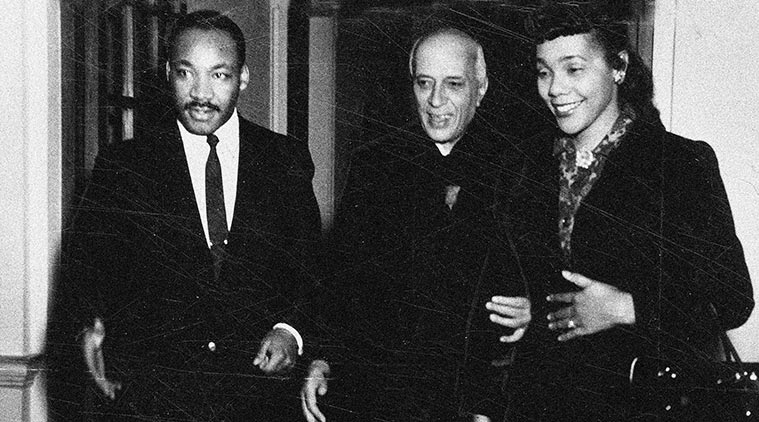
The Galtung Institute does introduce at the beginning of it’s biography that Gandhi’s idea are not original, but rather that “his mother’s religious devotion meant that his upbringing was infused with the Jain pacifist teachings of mutual tolerance, non-injury/killing of living beings (ahimsa), and vegetarianism.”
I’ll focus on the strong connection that the Civil Rights movement in the United States had with India and Gandhi’s practices of nonviolence. K-12 and college education managed to gloss over and skip the idea that movement are connected, and that MLK Jr. and and many civil rights leaders went to Inidea learn about nonviolence.
These same nonviolent tactics – which are much more successful than violent tactics – are used in current issues, ranging from Black Lives Matter, to Sunrise and other environmental movements, an If Not Now When‘s actions for Palestinian rights and human rights in general.
The news clips, which are just blips that happen every day and pass us by, tend to fail to mention that things are connected and that we are in fact in this together learning from one another across oceans.
Today, October 2, a hundred and one years after the birth of Gandhi, we celebrate International Day of Nonviolence in Gandhi’s honor and we learn from other struggles in order to to remember that we are in this together.
Happy International Day of Nonviolence!
As we approach the end of Climate Week (Sept. 21-27) it’s time to remember some of the climate news that has happened since mid-September.
On September 15, just a week before Climate Week began, ProPublica published a projected climate migration map of the United States suggesting that even with moderate carbon emission “much of the lower half of the U.S. [will] too hot or dry for the type of climate humans historically have lived in.”
Although “today, the combination of truly dangerous heat and humidity is rare” at our current emissions rate causing increase global warming, “
by 2050, parts of the Midwest and Louisiana could see conditions that make it difficult for the human body to cool itself for nearly one out of every 20 days in the year. New projections for farm productivity also suggest that growing food will become difficult across large parts of the country, including the heart of the High Plains’ $35 billion agriculture industry. All the while, sea level rise will transform the coasts.
According to The Hill, the same analysis by the New York Times and ProPublica suggested that “approximately 28 million people across the country could face Manhattan-size megafires by 2070, with Northern California residents experiencing them annually. ”
In essence, “nearly 1 in 2 Americans ‘will most likely experience a decline in the quality of their environment, namely more heat and less water,’ in the next 30 years, with changes being the most severe for 93 million people,” The Hill says, quoting parts of the study. Additionally, The Hill wrote, the analysis claims that by 2070, “four million Americans could find themselves living at the fringe, in places decidedly outside the ideal niche for human life.”
ProPublica began by talking about moderate climate emissions. On September 20th, Greta Thunberg provide an eye-opening statistic: Since 2005 “about one third of ALL the world’s fossil fuel CO2 emissions have occurred. Over half of our CO2 emissions have taken place since 1990.”
People, countries, and companies with platforms are making statements and setting goals, even if that goal isn’t sufficient. Prince Charles, the Prince of Wales, called for ‘swift action’; South Korea set a goal of net goal of net zero emissions by 2050, following China’s pledge to be at net zero by 2060; Walmart has set a goal of zero emissions by 2040; California plans to ban the sale of combustion engines – the ones that consume gas, and emit pollution – by 2035.
Peter Kalmus, a climate scientist, points out that South Korea’s pledge is meaningless, and a goal of net zero thirty years from now – or, as China suggests, forty years from now – is basically climate denial. In that vein, Walmart’s pledge to act twenty years from now is also simply passing the buck, or kicking the can down the road. Swift action is needed.
As I pointed out in Climate Clock, if we act within seven years to counter irreparable climate catastrophe the planet might remain livable.
Climate change and concatenate climate justice has become an important issue in politics. Biden has set the net zero emissions goal for the U.S at the year 2050; as I pointed out in Climate Marker, his plan doesn’t include actions detrimental to climate change, like ending fracking. Howie Hawkins of the Green Party proposes net zero 2030. Frankly, I don’t think that Republicans or libertarians have a climate plan.
While there are several paths to ensure that we don’t reach a point of irreparable damage all of those paths lead to decarbonization. Decarbonization, according to Volkswagon, is “literally means the reduction of carbon. Precisely meant is the conversion to an economic system that sustainably reduces and compensates the emissions of carbon dioxide (CO₂). The long-term goal is to create a CO₂-free global economy.”
While long-term goals are important, short-term actions are essential to implementing long-term goals. The time for statements about long term-goals is over; it’s time to implement the long-term goals by acting now.

The clock gives us seven years to runaway catastrophe. Do you really want to wait that long? Look around you. This year the fires in Australia, the floods in India and Egypt and Sudan and in the Gulf States, the hurricanes, the monsoons, the fires in California, Oregon, Nevada, Washington, the pandemic have all been made be worse because of climate change that human activity contributes to. We have the solutions to mitigate these disasters. Imagine seven (7) years from now if we don’t act.

