
Glass and Flood – in whole or in part
Glass
On November 9 and 10, 1938, the state-sponsored anti-Jewish riot that took place coordinated by top Nazi leaders became known as Kristallnacht, the night of broken glass. As part of Kristallnacht, the U.S Holocaust Memorial Museum says, the German police imprisoned about 26,000 Jewish men in concentration camps. Kristallnacht was not the beginning of the persecution of the Jews of Europe, and was not the beginning of the German concentration camps.
Kristallnacht was not the beginning, but became a formative event considered a pogrom by German Jews.
The concentration camps were where people were concentrated into a small enclosed area and forced labor was the norm, despite being different than the forced labor camps based on who administered them. They were different than death camps which were built “for the sole purpose of murdering Jews on a mass scale,” often using poisoning gas.
Less than a year after Kristallnacht Europe was at war. This became, after the fact, the Second World War. By the end of the war millions had been killed in the death camps and the concentration camps. The attempted mass extermination of the Jews during the 1933-1945 is now widely known as a the Holocaust. Legally, what happened is known as a genocide, both according to the Holocaust Museum and according the the definition of genocide.
Genocide “means any of the following acts committed with intent to destroy, in whole or in part, a national, ethnical, racial or religious group:
(a) Killing members of the group;
(b) Causing serious bodily or mental harm to members of the group;
(c) Deliberately inflicting on the group conditions of life calculated to bring about its physical destruction in whole or in part;
(d) Imposing measures intended to prevent births within the group;
(e) Forcibly transferring children of the group to another group.
Flood
Three years (and a couple months) after Hamas and resistance forces in Gaza launched Operation Al-Aqsa Flood and broke through the fence keeping them in the world’s open-air prison Gaza is literally flooding. Over the past few years Israel has systematically destroyed most of the buildings in Gaza, including homes. This has forced the population, which was more than two million in 2023, to largely live in tents provided by relief agencies, or in the remains of buildings that haven’t collapsed entirely.
After rain this week more than 70,000 tents in Gaza flooded, with people having no where else to go and no where else to keep what remains of their belongings. The rain may have affected more than 350,00 already displaced people in Gaza.More than a 100,000 tents are waiting in aid trucks at nearby crossings waiting for Israel to allow them permission to enter Gaza.
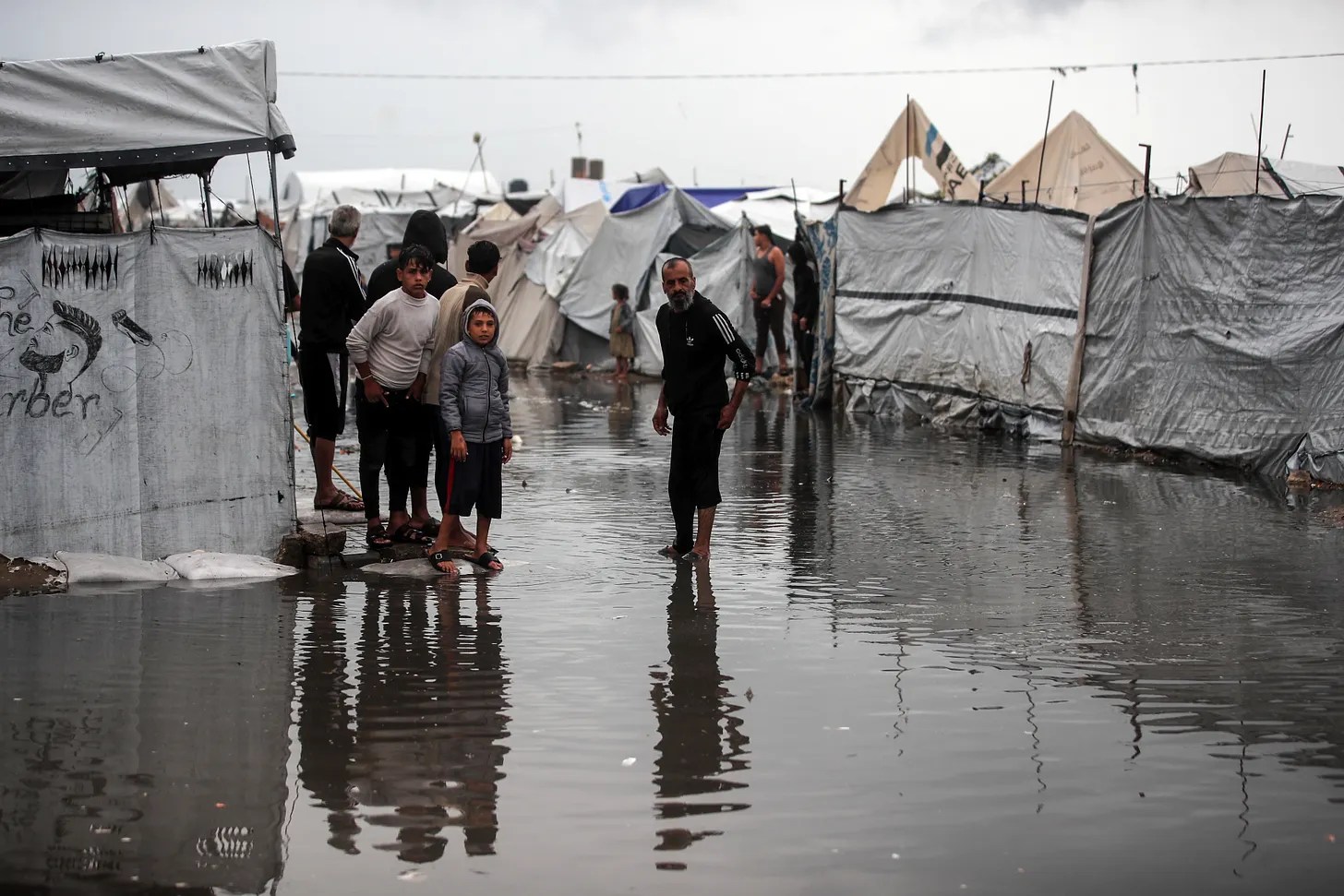
The reason the Palestinians in Gaza are living in tents is because Israel used the excuse of the Al-Aqsa Flood to commit acts with intent to destroy, in whole or in part, a national group – the Palestinians in Gaza.
GLASS and FLOOD
The definition of genocide, dratted legally as the Convention on the Prevention and Punishment of the Crime of Genocide, in December 1948, as an immediate response to the Holocaust will always have questions. It will always have naysayers who say that one a particular act doesn’t actually apply as genocide. Does the killing have to be immediate, or is a slow death and a slow but sure destruction genocide? Is it a genocide because it’s not the Holocaust? Is it a genocide if you push the remaining population toward the sea
No genocide happens in a vacuum. There was a history of oppression before the official Holocaust began, and there was a system of oppression of Palestinians in Gaza and beyond since before 1948, when Israel became a state. The resistance to the oppression led to Kristallnacht, and the resistance to oppression – the Al-Aqsa flood, after all nonviolent and other methods failed – led to the destruction of Gaza and the ongoing destruction of its people.

