
If your like me you don’t care about the Oscars. I just happened to turn it on – after some peer pressure – just in time to see the only part I cared about. No Other Land won an Oscar for best documentary.
It gave Palestinians recognition, bringing attention to the never-ending oppression and land theft happening the the occupied land that’s supposed to be part of a future Palestinian state.
No one ever stops to ask exactly how Palestinians will have a state when they don’t have land.
No Other Land‘s win also gave the co-director Yuval Avbraham a voice on international prime time. He used that time, Mondoweiss and others report, to condemn ethnic cleansing in Masafer Yatta, where the movie takes place. But he failed to condemn Zionism and praised “both-side’ism”.
It’s not that Israelis and Palestinians can’t live together, but that they can’t live as equals in the current system.
Yuval’s speech, Nada Elia correctly writes in Mondoweiss, condemns Zionism’s current actions without condemning Zionism. It was a speech of perfect hasbara (propaganda), calling for change without changing the system.
In the time and place of political opportunists Tulsi Gabbard has found her place.
The former Representative, and former Democratic candidate for president, has put her name forward to be head of the Department of National Intelligence under President Trump’s unsurprisingly far right-wing government.
In this role, created in the wake of the September 11, 2001 attacks, Gabbard would oversee 18 intelligence agencies with a budget of about $100 billion and serve as the principal adviser to the president on intelligence matters.
To Gabbard’s credit, in an McCarthy-like hearing in a Senate committee to out find if she was the right person, she failed to call former intelligence analyst and whistleblower Edward Snowden a traitor to the United States.
Later, according to NBC, Gabbard, who “had previously called for Snowden to be pardoned” reversed herself at the hearing, saying she would not seek a pardon or clemency for the former National Security Agency contractor accused of espionage.

Edward Snowden made the same mistake that Reality Winner, and other intelligence analysts have made. He released government information that the government was lying to, and spying on, its own citizens.
In the hearing in which Gabbard refused, correctly, to call Snowden a traitor she said about Snowden that “he broke the law”.
As Snowden himself has said, When exposing a crime is treated as committing a crime, you are being ruled by criminals.
Time will tell how wishy-washy Gabbard will be, either in this role or in any other.
Watching to fire in the Los Angeles area brings back memories.
The five fires that are burning around LA have burned 35,000 acres in the last week. It’s doubtless most destructive fire every in January in the United States, and is happening months after the end of California’s fire season, and well before the fire season is supposed to begin.
This isn’t the most destructive or most deadly fire California has seen, but it might be the most costly fire ever seen in the United States, at least a cost of $135,000,000,000 (135 billion), with property damage, lost wages and income, and disruption to the economy.
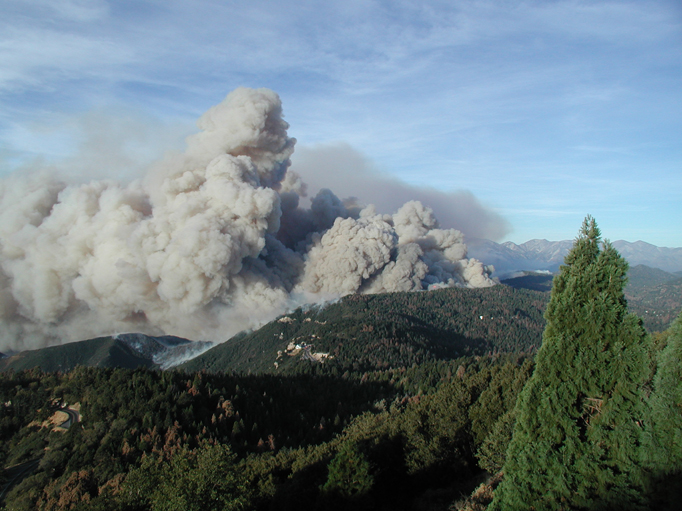
This fire brings back a lot of memories. When I was in high school in California in 2003 (did I just tell you my age?!?), California had the largest fire it had ever seen. Like the current fire, they were actually a collection of fires (fifteen) that happened at the same time in the same area. About 400,00,00 acres burned in the last week of October, and early November, covering areas from San Diego to the desert north of the San Bernardino Mountains.
The current fires, like the one in 2003 have been intensified by the Santa Ana winds, strong gusts of dry wind. The speed of the wind, intensified by climate change, makes fire spread quickly. Fire can sixty miles away, and with little time it’s at your doorstep. It’s unheard of to have huge fire in January, but California has been in a drought that makes it easy to burn once the fire has started.
In 2003 I watched from the Webb School of California, as fire came up from the hills to the east, slowly spreading toward the Inland Empire between San Bernardine and Los Angeles. The school evacuated 200 teenagers, asking us to take just a sleeping bag and other essentials, to a school a few miles south. I feel like recalling this was late in the evening. We slept – if there was much sleep by several hundred teenagers in the same room – in a large auditorium, and then spent the next week scattered to whatever evacuated places we could find. I stayed in a friend’s house, a few miles away….
During the same fire, around the same time, my parents had to evacuate. The fire, which started in the canyon between San Bernardino. and the San Bernardine mountains to its north (Crestline, Big Bear), blocked the main road to San Bernardino; my mom had a friend who alerted her and she got out just before the road closed. What do you grab except the two dogs, and some clothes? … My dad wasn’t home, he was further north toward Santa Barbara. He got a call – no cell phone at this time – and he came up the back (north) side of the mountain. Instead of evacuating, he stood on the roof with a fire hose.
The wind pushed the fire right up the the rim of the mountain, where some houses burned. We were a hundred yards from the rim, a couple roads down. Houses burned above us, and further down into the valley. Houses in San Bernardino, at the base of the mountains burned. It was a hit and miss with no rhythm to it, and any house could have burned.
Fire is mesmerizing. It’s addictive to watch the news on the weather station and see what’s burning. This is very familiar. It’s entirely surprising and unpredictable.
My most recent letter to Congress was prompted by the destruction of the Kamal Adwan Hospital in Gaza, and the subsequent abduction of Dr. Safiya, head of the hospital. Israel has “transferred” Safiya to the infamous and abusive Sde Teiman military base and detention center.
The fact that neither my Congresswoman nor my Senators has issued a press release or commented on this tragedy of intentional destruction of a hospital, and the abduction of the head doctor (and many others, who weren’t immediately and intentionally burned alive) is troubling.
I sent this to my Representative in Congress, and both Senators.
Dear _______,
I’m writing to you as a constituent and as a Jewish American troubled about current actions by Israel. As you know, the last functioning hospital in north Gaza was destroyed last week by Israeli forces, after weeks of besieging and attacking the hospital.
The director of the hospital, Dr. Safiya, has been captured by Israelis and has been taken to one of the most abusive and troubling “detention centers” run by Israel.
I want to remind you that it’s never okay to destroy a hospital, even in wartime or for any military need. “Detainees,” who are really political prisoners, are expected under international law to be treated humanly. It doesn’t matter whether they are expected of terrorism. This applies to all 10,000 Palestinian prisoners held by Israel, and many other political prisoners. (See the the information from B’tselem, an Israeli human rights organization: https://www.btselem.org/statistics/detainees_and_prisoners)
I ask that you immediately issue a press release calling for Dr. Safiya’s release, and that you work with your colleagues and the executive branch to free political prisoners now.
Israel’s actions are very troubling to me as a Jew, and as your constituent.
I encourage you to read NBC’s article, which reminds us that “Hospitals and medical workers are considered protected under international law, which states that they must never become targets in warfare.”
Thanks again for your representation,

Long before Hamas and other resistance movements penetrated Israel’s defense around Gaza last October Gaza was relegated to economic peace. Almost all commentary suggested that by failing to address the undermining political and economic realities that Palestinians face in Gaza and beyond Israel is entrenching the status quo of cycles of latent and physical violence.
WHAT IS ECONOMIC PEACE
Economic peace is the notion that if you give people economic opportunities other issues that might lead to conflict would be mitigated. Capitalistic to the core, and based on modern economics, economic peace suggests that if every one is well off – or has the opportunity to be well off – other issues, like land theft – will be bygones and two different cultures with two different histories and narratives won’t have further disputes. Economic peace is at best a fig-leaf designed to reject that other issues need to be addressed.
Professor of economics, Ibrahim Shikaki wrote about how economic peace only entrenches Palestinian reliance on Israel. He was writing just after another large scale attack on Gaza, in 2021. The international community responded, as usual, “by organizing a humanitarian mission for aid and reconstruction in the besieged Palestinian enclave” after the noticeable violence ended.
“Although a humanitarian response is sorely needed in Gaza,” Shikaki wrote, “failing to also address the political and economic realities Palestinians face will only entrench the untenable status quo of Israeli occupation and likely lead to further violence.”
Economic peace plans for Israel and Palestine are everywhere, Shikaki continued. Under Obama, Secretary of State John Kerry pushed his plan, and under the first Trump presidency the Kushner Plan promoted economic peace. (Links found in the Shikaki article in Foreign Affairs, but this information can be found elsewhere). Explaining how economic peace entrenches Palestinian reliance on international donors, Shikaki says that reports from the World Bank and the International Monetary Fund “calling for unhindered economic ties between the Palestinian and Israeli private sectors” are also economic peace plans. Economic peace, he says, is “a flawed theory that assumes there is an economic solution to a political problem” that suggests economic incentives will keep Palestinians from demanding their right to self-determination.
Shikaki is not alone in suggesting that economic peace is a flawed theory. Yossi Alpher, an Israeli security analyst, wrote in October 2024 that “Prior to October 7, 2023, Netanyahu thought he had a working strategy of buying off Hamas (“economic peace”) and deterring Hezbollah. He made no secret of this. It failed completely.” A year earlier, writing in December, 2023, Alpher summarized the still-fresh events of October saying that among Netanyahu’s “failed strategies for managing relations with the surrounding Arab world” was ‘economic peace’ – “it magically assumed that the Israeli-Palestinian conflict was economic in nature rather than territorial, ideological, historical and religious. We saw how economic peace worked on October 7.”
Alpher added that economic peace, specifically related to Hamas in Gaza, has been around for a long time. In 2009, a couple months of taking office yet again, Netanyahu called “on the Arab countries to co-operate with the Palestinians and with us to advance an economic peace.” More recently, following the Trump-era (Biden-supported) Abraham Accords, Netanyahu has collaborated with Qatar in hopes of advancing advancing economic peace in relation to Hamas.
HOW DOES ECONOMIC PEACE WORK
Shikaki, in his Foreign Affairs article, reminds us that “between 15 and 40 percent of the total Palestinian labor force worked in Israel at some point in the last 50 years and even more worked for the Israeli economy via subcontracting in the occupied Palestinian territories.” More than 1200,000 Palestinians from the West Bank or Gaza were working in Israel in 2022.
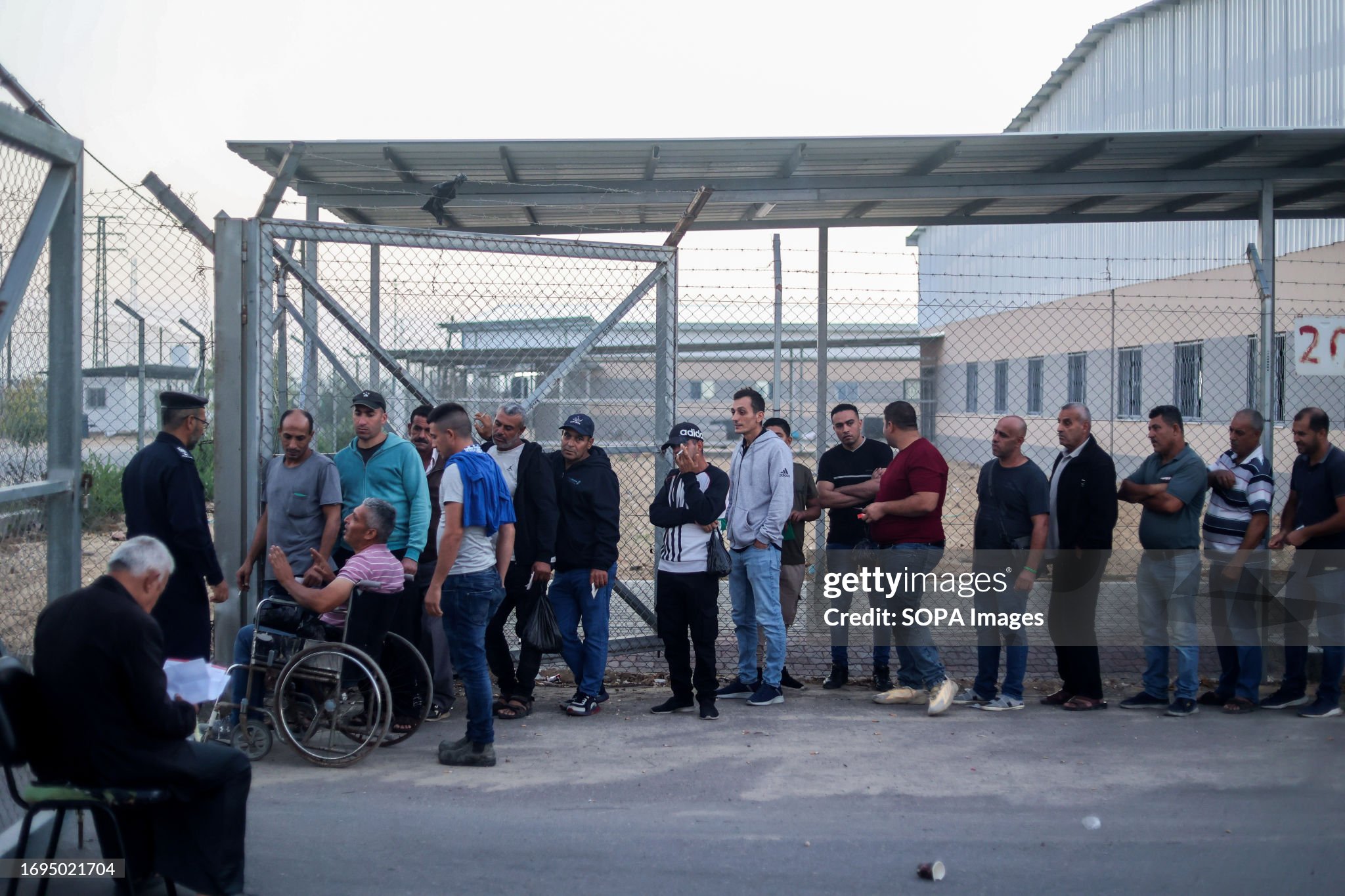
Shikaki continues, “the Israeli economy has made use of Palestinian labor to ensure low costs of production while opening Palestinian markets to its goods”. Shikaki says, “little has changed since the establishment of the Palestinian National Authority in 1994 through the Oslo peace process.” More workers, until October 2023, were working in Israel, but it provided an economic fig-leaf, not a durable solution to a political problem.
The whole process made Palestinians dependent on foreign investors and private debt, and Israelis somewhat reliable on cheap labor from Palestinians. NPR‘s “Israel’s war with Hamas disrupts Palestinian workers and Israeli employers alike,” said in November 2023 that “left without those [Palestinian] workers — and without alternative sources of labor, as Israeli reservists have been called to war and many foreign workers have fled the conflict — the construction industry in Israel is operating at 15% of its prewar capacity, according to the Israel Builders Association, an industry group.” Meanwhile the Palestinians in the West Bank, “the sudden shutoff of income has rippled through the economy, as workers struggle to pay their rent, car payments and children’s tuition.”
Somehow this doesn’t sound like it leads to peace.
King Wenceslas and the Feast of Steven have been immortalized by Love Actually. Good King Wenceslas, who was a duke, and not a king, was born in 907 according to Wikipedia.
Wenceslas’s father was named Vratislaus and his mother Drahomíra. Vratislaus’ father Bořivoj, also a duke, and his grandmother Ludmila converted to Byzantine Christianity. It was Ludmila who ensured Wenceslas received a Christian upbringing. In today’s world perhaps this wasn’t shocking, but eleven-hundred years ago Christianity was relatively new.
In 921, when Wenceslas was about 14, his father died and he became duke. Considered too young to rule – ask Edward III of England (king at 14, began rule at 17), or Louix XIV of France (king at 4, began rule at 17) – Ludmila declared herself regent. Jealous over her mother-in-laws control over her son assassins, on the order of Drahomíra, murdered Ludmila on 15 September 921. Drahomíra, Wikipedia says, took over the regency and initiated measures against Christians.

When Wenceslas was eighteen, remaining Christians nobles led an uprising, and Drahomíra was exiled. Wenceslas was remembered as a good king. All kings are good until proven otherwise, of course. Lots of things happened – military victories and defeats, and importantly the expansion of Christianity. I’ll skip the details, which can be found on Wikipedia because there’s not a lot of original sources about Wenceslas. In September 935, Wikipedia says, “a group of nobles allied with Wenceslaus’s younger brother Boleslav plotted to kill him”. Using the oldest trick in the Game of Thrones book, Boleslav invited Wenceslaus to a celebration of the feast of Saints Cosmas and Damian, at which point three of Boleslav’s companions stabbed Wenceslas to death. Apparently, Boleslav then ran Wenceslas through with a lance.
Wenceslas was assassinated. His grandmother, Ludmila, was assassinated by Wenceslas’s mom.
He was almost immediately made a saint and a martyr, and stories and biographies of Wenceslas appeared very quickly. Considering this was the Dark Ages and very few people theoretically knew how to write, this is fairly impress.
Good King Wenceslas, a song with lyrics appeared in 1853. (Not long after his death, Wenceslas was given the title “king” by the Church). The song refers to “on the day of Steven,” or Saint Steven’s Day, (December 26), and is partly made famous by Hugh Grant in Love Actually.
A relatively minor rule in history, who was just one of thousands of chiefs, barons, dukes, and kings, Wennceslas might best remember for being dead. His death, which made him a martyr – because the people said so – and a saint – because the Church said so – made him famous. The myths of what he accomplished has led to poets, songs, and more. He was given, several hundred years later, the aura of a noble and just leader which provided him Saint Stevens Day – the second day of Christmas.
His life of twenty-two years, full of intrigue and assassins has been forgotten. Now he’s Good King Wenceslas.
A few months after Prime Minister Netanyahu assembled the most right-wing government in Israeli history at the end of 2022, Alison Speri wrote an article in April of 2023 for The Intercept that begins with the story of Masafer Yatta.
Speri’s “Lab of Oppression” is behind a partial paywall for The Intercept. You can access a particular number articles a month, and after that you can join The Intercept for free by adding your email address. You might or might not be able to access this article.
The story begins in Masafer Yatta. A collection of halmets in the Hebron hills surrounding Yatta, Masafer Yatta is one of many areas across the occupied West Bank where the Israeli state has for decades forced out Palestinians and replaced them with Israeli settler. The goal, as Netanyahu “stated plainly” after returning to power, “is to give the state absolute control over what he called ‘all areas of the land of Israel’ – including land widely expected to one day form the territory of a Palestinian state.”
Lab of Oppression is a story of people, structural oppression, and the laws designed to oppress people. It’s a reminder that Palestinians have long faced oppression, as both whether they’re citizens or refugees under international law. Israel has done everything it has can to not implement peace agreements, and to maintain and increase modes of oppression against occupied Palestinians. The increased violence over the last fourteen months, which can’t be called a war, was precipitated by this oppression, and has allowed settlers, with state backing, to increase (undefined) all areas of the land of Israel.
A year ago Hamas fighters, along with other political factions of Palestinians, did the impossible and broke through the open air prison that is Gaza. We know that about 1,200 people died – mainly Israelis along with some foreign nationals from Asia that everyone’s forgotten about – and that Hamas and allied took about 250 people hostages back to Gaza – mainly Israelis, bu also other foreign nationals including U.S. residents.
We also know that a year ago, on October 7, 2023, Israel enacted the Hannibal Directive, “designed to prevent soldiers from being taken alive as prisoners of war – by killing many of its own civilians,” and that of the 1,200 killed last October hundreds were killed by Israeli forces.
There are a couple reasons Hamas did what it did. During his time as president Trump signed the Abraham Accords, which was designed to improve economic relations between Israel and Arab states WHILE intentionally ignoring and negating Palestinian sovereignty and the idea of a Palestinian state. Trump’s reversed long-standing policy and insulted international law by moving the U.S. embassy to Jerusalem, and his policies toward the Palestinians was to exclude them and ignore them.
President Biden has attempted to continue to strengthen the Abraham Accords, and specifically tried to get Saudi Arabia to join the accords. The Saudis are interested, but have refused – last summer, before, and over the last year – unless the Israelis recognize a a Palestinian state and Palestinian right to self-determination.
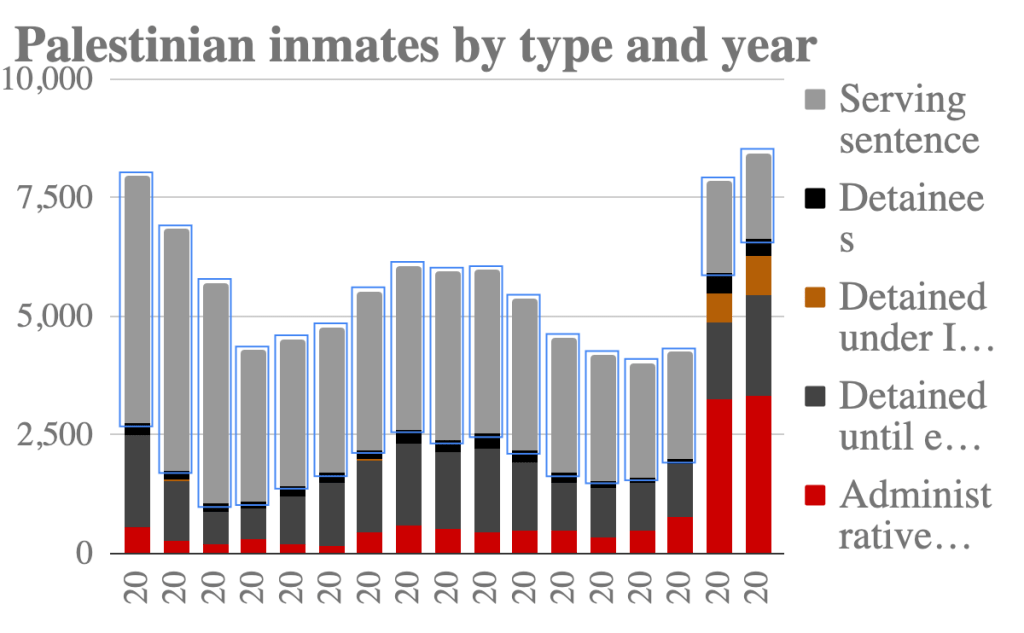
A second reason is that there are 10,000 Palestinians in Israeli prisons, and every one of them is a political prisoner. This number of prisoners is from June, 2024; a year ago it was still over 5,000 Palestinians. Hamas thought that by taking hostages, they’d having bargaining chips (people) to trade to get Palestinians out of prison. It’s been a successful method before.
We know that Hamas offered to free all 250 prisoners in exchange for the Israeli army not entering the Gaza Strip, and that they offered this on October 9 or 10 of last year. Reporting on this in The Times of Israel, Gideon Allon suggests that for months Netanyahu has rejected a peace deal because it’s politically detrimental to him.
Most Arab states are hesitant to say anything or maintain anything other than tepid peace deals the status quo with Israel, and the Saudis don’t say anything other than not joining the Abraham Accords. Non-state Arab groups have become involved with the Houthis in Yemen successfully blockading the Gulf of Aden leading to Red Sea, despite years of a civil war in Yemen, and Hezbollah in Lebanon began exchanging a small arms battle in Israel’s north.
That changed in the last month when Israel assassinated the leader of Hamas, who was was in Iran, paying respects to the sudden death of Iran’s president in an airplane crash. Assassinating enemies, during war or peace, is an extreme tactic. In September, 2024, Israel assassinated the leader of Hezbollah in a carpet bombing campaign of Beirut, and, a few month later assassinated the likely next leader of Hezbollah, also killed by a bomb.
In Israel’s bombing campaign against Lebanon in last month, Israel also bombed Syrian troops on the border of Lebanon and at the same time killed members of the Iranian army. It’s clear that Israel has also been using the Dahiya Doctrine, which calls for “massive, disproportionate force and the deliberate targeting of civilians and civilian infrastructure.”
In response Iran has launched two measured attacks against Israel, using mostly drones to attack military bases and army structures.
Israel now has the war it has always wanted. It’s able to claim it’s under attack by all it’s enemies and it’s able to cry – incorrectly – that the world is anti-Semitic and that’s why it’s attacking Israel. Israel ha always wanted, especially under Netanyahu, a war with Iran.
Violence – physical and structural – against the Palestinians has been going on for a little more than a century.
A year after the most recent attack on Gaza began, it’s long past time to destroy the system of oppression and neglect the Palestinians face.
Starting on September 16,1982, Palestinians refugees, along with Lebanese civilians, were attacked by a right-wing Lebanese militia, in coordination with the Israeli army.
They were in the refugee camp Shatila, Lebanon, and the adjacent neighborhood of Sabra; located southwest of Lebanon’s capital city Beirut.
How did they Palestinian refugees end up in Lebanon? Al-Jazeera staff, writing in “Sabra and Shatila massacre: What happened in Lebanon in 1982?” remind us that ‘the refugees were victims of the 1948 Nakba, or “catastrophe” in Arabic, fleeing the violent ethnic cleansing of Palestine by Zionist militias as Israel was formed.’ About 100,000 Palestinians fled to Lebanon in 1948, permanently becoming refugees of war.
Al Jazeera, providing a brief background, says the PLO [Palestinian Liberation Organization], an umbrella of Palestinian political parties created in 1964, moved its base of operations to Beirut after it was pushed out of Jordan in 1970. The PLO, Al-Jazeera says, was created “with the aim of liberating Palestine through armed struggle.” Non unlike Hamas, which was created with the to liberate Palestine through armed struggle during the First Intifada.
In 1969, Al-Jazeera, continues, as result of an Egyptian-brokered agreement between the PLO and the Lebanese army, the PLO’s Armed Struggle Command assumed control over the 16 Palestinian refugee camps in Lebanon, enabling it to carry out operations on Israel from southern Lebanon.
Here, Al-Jazeera begins to get to the history that led to the massacres in Sabra and Shatila. Skipping the causes of what led to a civil war, the article continues that a Lebanese civil war broke out in 1975, mainly between the Lebanese Front (LF) – a coalition of right-wing Christian Maronite parties backed by Israel and the United States – and the Lebanese National Movement (LNM), a coalition of secular leftists, pan-Arab Sunni and Shia Muslims, and the PLO.”
In 1982 Israeli forces, led by then-Defense Minister Ariel Sharon, invaded Lebanon. Israeli forces “laid siege to Beirut and heavily bombarded the city.” The PLO was headquartered in Beirut. Here, the Institute for Middle East Understanding (IMEU) provides information missing from Al-Jazeera’s description of the Sabra and Shatila massacre. The IMEU adds that “under a ceasefire deal negotiated by the administration of US President Ronald Reagan, the PLO evacuated Lebanon by early September with written assurances from the US that the hundreds of thousands of Palestinian civilians they were leaving behind would be safe.” However, Al-Jazeera continues, “the multinational force that arrived after the PLO’s withdrawal from Beirut on September 1 was supposed to stay for 30 days. However, they pulled out early, on September 10.”
The IMEU continues, “On September 14, the leader of Israel’s proxy Lebanese militia, the Phalange, was assassinated after being elected president of Lebanon by parliament in a move orchestrated by Sharon and Israel’s occupying army. His death was a severe blow to Sharon’s plan to install a Christian puppet regime in Lebanon that would do Israel’s bidding. The next day, the Israeli military broke the ceasefire agreement and invaded West Beirut, surrounding Sabra camp and Shatila. Simply, as Al-Jazeera, puts it, “Israeli forces then allowed the Phalange, who blamed the PLO for Gemayel’s death, to enter Sabra and Shatila and carry out the massacre.”
What do we mean by massacre? In the 43 hours of killing between September 16 and September 18 the Lebanese Phalangists killed 2,000-3,500 people – mostly Palestinian, but also Lebanese women and children. Many were raped and mutilated, and buried in mass graves.
The IMEU provides the information that “Almost immediately after the killing began, Israeli soldiers surrounding Sabra and Shatila became aware that civilians were being murdered but did nothing to stop it. Instead, the Israeli military fired flares into the night sky to illuminate the darkness for the Phalangists, allowed more Phalangist fighters to enter the area on the second day, and supplied bulldozers that were used to dispose of the bodies of many of the victims.”
The United Nations passed a resolution declaring the massacre a genocide.
The IMEU and Al-Jazeera both confirm that no one was ever held accountable for the massacres. Al-Jazeera mentions that “In February 1983, the UN commission found that “Israeli authorities or forces were involved, directly or indirectly in the [Sabra and Shatila] massacres,” and the IMEU adds that “
In particular, Defense Minister Sharon bore responsibility for the massacre. He planned and initiated Israel’s unprovoked invasion of Lebanon, cultivated the Phalange as an Israeli proxy, and did nothing to stop the massacre when told about it until forced to by the Reagan administration.
While the Phalange carried out the massacre, they were an Israeli proxy, armed and funded by Israel. Israel’s occupying army was in full control of Sabra and Shatila and sent the Phalangist fighters into the camp knowing full well their hatred of the PLO and history of atrocities against Palestinian civilians.
Every years Palestinians worldwide remember the Saba and Shatila massacres. Writing on the thirty-eight anniversary of the massacre, the Arab-American Discrimination Committee (ADC) wrote “the Sabra and Shatila massacre remains one of the most symbolic events in the history of the Palestinian people and their plight. The massacre demonstrates the tragedy of the Palestinian refugees, who have been dispossessed from their homeland for over 70 years. This tragedy is an example of the need for a just settlement of the refugee issue based on the United Nations General Assembly Resolution 194, which affirms the right of return for Palestinian refugees.”
The ADC notes that the anniversary follows the recent anniversary of the Abraham Accords – the agreement to “normalize” relations between Israel and Arab countries. The Accords – pushed through under President Trump, and still supported by President Biden, who hopes to expand the Accords, “whitewash the occupation of Palestine and ignore the human rights violations of the Israeli apartheid regime. Human rights violations that include the very massacre that we are remembering today.”
The Palestinian BDS National Committee, writing today, echoes, the ADC’s words: “This massacre is a stark reminder of Israel’s ongoing violent massacres, displacement of Indigenous Palestinians, and its denial of our refugees’ right of return.” The BDS movement website has specific calls to actions to undo the ongoing genocide and attacks on Palestinians rights.
This is a brief summary of the massacre on Sabra and Shatila, Israel’s quest to control and/or subjugate Lebanon, and a denial of Palestinian rights. For a more complete version I suggest reading Noam Chomsky’s magnum opus, The Fateful Triangle..
Aysenur Eygi’s killing in the West Bank by Israel on September 6, as she engaged in a nonviolent protest protecting Palestinian land from land theft and encroachment by illegal settlers caught the world’s attention. Even members of Congress responded, as well as Vice President – and nominee for president – Kamala Harris, who called the death “a horrific tragedy that never should have happened.”
Not all members responded, and some don’t seen to be concerned with the death of not only tens of thousands of Palestinians using weapons provided by the U.S. government, but also with the death of U.S. citizens – as long as the death comes by the hands of an ally.
Remembers to thank elected officials who call for accountability, and to call out the rest, and demand they represent us. You might right something like the following to your elected officials who haven’t taken action.
Dear Representative,
I’m writing to you as a constituent about the death of Aysenur Eygi.
Aysenur, a U.S. Citizen, and a recent graduate of University of Washington was fatally shot in the head by Israeli forces in the West Bank on September 6.
I’m asking that you join your colleagues in Washington – Senators Murray and Cantwell, Rep. Jayapal – and beyond in calling for a thorough, independent, investigation into Aysenur’s death. President Biden and the executive branch are waiting for an investigation by Israel, but Israel never conducts investigations; they perform cover-ups.
Israel never conducts investigations; they perform cover-ups.
Please work with your colleagues to determine whether Aysenur was killed with a weapon provided to Israel by the United States. Further, please work with the FBI to determine whether the Justice for Victims of War Crimes Act (18 U.S. Code § 2441) applies in this case. All domestic and foreign actors that contributed to the Aysenur’s death should be held accountable.
Aysenur’s death was not the only recent death of U.S. citizens, other foreign nationals, or Palestinians killed while peacefully protesting recently in the West Bank.
I ask that you call for an investigation and and push for accountability.
Thanks again for your representation.
 The Dole Blog