
This morning I spoke to the state investment board about their obligation under international law to not provide material support Israel. What I said is a shortened piece of a letter to the editor – which itself requires brevity. I was given two minutes to talk this morning, and below is what I said, excluding some introduction about my name and connection to the issue:
Last year the International Court of Justice passed a ruling, concluding that Israel’s continued seizure of the the Occupied Palestinian Territory (OPT) of East Jerusalem, Gaza, and the West Bank is illegal under international law and that it must be ended immediately. The court asserted that countries, and states within them, are obligated NOT to recognize Israel’s illegal acts, and must REFRAIN from providing aid or assistance that maintains Israel’s illegal presence in the OPT. The UN General Assembly passed a resolution supporting the findings of the ICJ.
Simply, this means that we as people, and you as a board, have an obligation to not invest in any company within Israel, or with any company that provides Israel material support such as shipping, or mass surveillance.
Thanks for your time today, and you attention on where our collective money is invested.
I hope you find your own words to write to to newspapers and to speak to the powers that be to ensure our money is invested in a way that does not create harm.

I recently did what is somewhat expected in society, although one person called it one of the hardest things we can do, and asked a woman out. There’s some unwritten expectation that as a the guy – or the man – I’m supposed to be the one to take the lead. As the older person – I know I’m older – there’s some expectation that I act like the responsible adult.
I don’t think I’ve asked anyone out since prom in high school when I asked a long-time friend who was in a different school.
If you’re the person I asked out, and you’re reading this, don’t worry. I like you and will continue to like you. I love you for who you are, for your values and your worldview.
I’m not good at looking at it as asking her out. I don’t know that I even want to call it a date. I wanted and want to spend time with her to get to know her better, and, frankly, just to spend time with her because I enjoy spending time with her.
There was a lot of anxiety about asking her. Almost as much anxiety as deciding whether to press the ‘friend’ button on social media. The anxiety wasn’t about her, but about me. Was I doing the right thing? Would I hear a yes? Would a hear a no? Would I push her away? All of these things worried me.
Anxiety
Merriam-Webster defines anxiety, in the medical sense, as “an abnormal and overwhelming sense of apprehension and fear … concerning the reality and nature of the threat, and by self-doubt about one’s capacity to cope with it.” the American Psychological Association defines anxiety as “an emotion characterized by feelings of tension, worried thoughts, and physical changes like increased blood pressure.”
I mentioned to a friend about the anxiety of relationships, and how hard it is to meet people and make friends once we become adults and have left college.
The social media algorithm picked up on the words ‘relationship,’ and ‘anxiety,’ and ‘overthinking’ and gave me lots of reels to look at and pages to look at that I don’t follow.
Many of the reels and stories I’ve come across while doomscrolling, or scrolling without knowing that I’m looking for, are useless and irrelevant. Most reels are how to deal with a break-up, which is useless to me, or how to send the perfect message, or determine by body language if the person really want you. Some said that if she’s not responding to your texts – leave the relationship. Again, pointless because who I’m thinking of does respond to my texts and hasn’t ghosted me, and we have a relationship beyond whether the answer to “can I take you out” is a ‘yes’ or a ‘no’. (Although for several weeks I had anxiety of whether we can exist beyond that question for several weeks, I think the answer is we’ll be fine).
Attachment Types
What I did learn from the reels is that everyone brings an attachment type into a relationship. It’s not news that everyone has emotional baggage they bring into a relationship, but I’d never thought about attachment types. We all have issues from our childhood that we generally know nothing about that determines how we interact with romantic partners.
An experiment from 1969 showed that there are four attachment types: “One is secure attachment. The other three — anxious, avoidant and disorganized — are considered insecure attachment styles.”
Each style, continues an article in Cleveland Health about the four attachment types, “exists on a spectrum, so you may not find yourself identifying completely with any one style. Or your style may fall into one category but be more or less extreme in how it affects the quality of your relationships.”
- Secure attachment in a an adult relationship People with a secure attachment style “are more readily able to form long-lasting and healthy relationships with others. They’re more likely to trust their partner and be emotionally available to them.” Studies show that about 58% of adults are securely attached.
- Anxious attachment style “may be seen as ‘clingy,’ ‘needy’ or not trusting. People with an anxious attachment style can be consumed with concern that their loved ones will abandon them, and they may seek constant reassurance that they’re safe in their relationship.” Research indicates that about 19% of adults have an anxious attachment style.
- Avoidant attachment “can look like an adult who is a “’one wolf’ or overly self-sufficient. People with an avoidant attachment style are likely to not delve much into emotional conversations, either in regard to their own feelings or those of others.” The article adds that “adults with an avoidant attachment style can be seen as self-reliant and emotionally guarded. They’re unlikely to seek emotional comfort or understand how to comfort their partner.” Research shows about 23% of adults have an avoidant attachment style.
- Adults with disorganized attachments are likely to live with mental health disorders or personality disorders that prevent them from developing healthy relationships with others. They’re likely to crave close relationships but push others away when they show them attention. Cleveland Health does not mention the percentage of people that fall under this category.

There’s a lot more information about how each attachment style develops and about labeling yourself our your partner with one or more of these elements of attachments and attempting to understand upbringing as a child.
I spent a long time (or at least a while) trying to understand myself, and the person I asked out in terms of these attachment styles. I can see myself having more than one of these attachment styles at the same time, although I can’t tell you what part of my childhood caused what. As for anyone else, since we often develop these styles as children without knowing it, you may relate to these styles without knowing why.
In another edition of IT’S TIME TO WRITE TO YOUR ELECTED OFFICIALS I recently send this letter to my Senators, Congresswoman, and the President.
I encourage you to find your own words and write to your elected officials.
….
Dear Representative,
I’m writing to you to as a constituent, and as an American Jew, to emphasize that safety to Jews in the United States and beyond is intrinsically tied to the actions of the Israeli government as long as it claims to act in the voice of all Jews.
While Israel continues its unnecessary and disproportionate assault on the population of Gaza, the safety of American Jews deceases and anti-Semitism increases.
I ask you to immediately take action to condemn Israel’s assault on the Palestinian people, and make clear that while this assault on Palestinians continue, your constituents are less safe.
Thanks again for your representation.
It’s been 600 days since Hamas and other resistance groups in Gaza broke through the fence that keeps them in Gaza, and returned to Gaza with more than 200 Israeli and foreign national as hostages.
About 1,200 Israelis and foreign nationals died that day, which is horrific number on the Israeli side – a number that was unfathomable. It has become clear that Israel killed many of those 1,200 people, many of who were civilians, as they enacted the Hannibal Doctrine which allows Israelis forces to fire on on their own solders and civilians in order to prevent soldiers and civilians falling into enemy hands.
We’ll never know exactly how many of the 1,200 were killed by Israel. We do know that at this point, more than 50,000 Palestinians have been killed in Gaza by Israeli forces. The number may be several times higher, because only bodies who have been identified are counted, but not the thousands buried under the rubble or crushed to death beyond recognition. More than 75% of the Palestinians killed are officially woman and children. More than half of Gaza’s population is under the age of 18. Israel is waging a war on children.
All elements of life have been targeted and destroyed in Gaza. Schools, colleges, hospitals, mosques, churches, and every other element of society. Israel has been accused of targeting hospitals and medical workers and journalists, as well as scholasticide and genocide. Israel succeeded, with the help of the United States, to defund UNRWA, the UN Refugee of War Agency responsible for providing the basic education, healthcare, and food, that, as the occupying power Israel has a responsibility to provide to the people of Gaza. Since the last ceasefire, designed in Israel’s favor to allow the release of hostages, collapsed in February of this year Israel has prevented food, fuel, or anything else to be allowed into Gaza over the last two and a half months.
Efforts to outsource the distribution of food to U.S. paramilitary forces is ongoing while it’s estimated that thousands of Palestinians will starve to death.
In response to the humanitarian situation in Gaza, the UN Office of the Coordination of Humanitarian Affairs (OCHA) issued a statement about Israel’s obligations under international law.



For years I’ve been working on a mathematical equation that I haven’t got quite right or been able tp prove. The facts are easy enough: when two people are having a conversation, there’s actually three conversations going on. One inside each person’s head, and one between them (even if there’s no talking). Which means’ there’s 7 conversations between three people, etc. I think it’s #people x #people + 1 + the # of people in the conversation, or something like that.
Thinking of mathematical proofs – which is not my strong point -reminded me of Yom Tov Lipman Lipkin. Referring to Wikipedia (where else?) it says that with Charles-Nicolas Peaucellier, Lipkin invented the first true planar straight line mechanism – the first planar linkage capable of transforming rotary motion into perfect straight-line motion, and vice versa. Wikipedia continues,
Until this invention, no planar method existed of converting exact straight-line motion to circular motion, without reference guideways. In 1864, all power came from steam engines, which had a piston moving in a straight-line up and down a cylinder. This piston needed to keep a good seal with the cylinder in order to retain the driving medium, and not lose energy efficiency due to leaks. The piston does this by remaining perpendicular to the axis of the cylinder, retaining its straight-line motion. Converting the straight-line motion of the piston into circular motion was of critical importance. Most, if not all, applications of these steam engines, were rotary. The mathematics of the Peaucellier–Lipkin linkage is directly related to the inversion of a circle.
Yom Tov Lipman Lipkin, Wikipedia says, was the youngest son of the “famed” son of Rabbi Israel Salanter, or the Salanter Reb (Rabbi). The Salanter Reb was the founder of the modern Mussar Movement, which might be called ethical Judaism. What I heard growing up, and what I listed on my genealogical chart for high school, is that the Salanter Rabbi is my great-great-great-great grandfather (and I’m otherwise unrelated to Yom Tov Lipman). Some in town question whether this could be true, because apparently everyone wants to claim the Salanter Reb as an ancestor.
The Ethical Will
I was interested in looking for the ethical will from the Salanter Rabbi. An ethical will is a series of moral instructions to a persons descendants on what he want them to do – first, in the sense of how he should be buried, and second, how his children and grandchildren should live life.
It turns out that the beat up, taped-together-with-painters-tape, ethical will – with English translations – was not for the Salanter Rabbi, but for another ancestor, Rabbi Joseph Moses Abraham Levinski, known as the Tzadik [a good moral and spiritual leader] of Lazday.
I interrupt these thoughts to say that I’m not bragging about my ancestry, or tooting my horn. What we know and what we can know of our ancestors, and their lives, and what expectations they might have of us, though, is fascinating and important. The English version of the ethical will that I’m referring to were organized by cousins – second, third, or fourth cousins – who were equally interested in their ancestry, and shared with my grandmother because she remained interested in her family history.
The Tzadik’s ethical will mentions the Salanter Rabbi and the Mussar movement, which called him “the founder and spiritual leader of the Mussar Movement.” It gives a history of other rabbis that influenced Israel Lipkin – the Salanter Rabbi – and describes Mussar as the improvement and refinement of the human person.
In this sense the ethical will of Joseph Levinki, written before cars and most modern amenities we take for granted, remains relevant and interesting.

An image of the ethical will of Rabbi Joseph Moses Abraham Levinski, taken from the internet.
If you;re feeling lost and don’t know what to do to help the Palestinians in Gaza, the West Bank, and beyond as Israel continues its assault that some have now referred not only as a genocide, but worse – a holocaust – write to your members of Congress and other policy makers.
Below is the message I recently sent to my representatives in Congress:
I’m writing to you as a constituent to emphasize that we are obligated to follow international and domestic law.
The International Court of Justice ruling, in July 2024, concluded that Israel’s continued seizure of the the Occupied Palestinian Territory (OPT) of East Jerusalem, Gaza, and the West Bank is illegal and that it must be ended immediately, and that through annexation and permanent control Israel continues to frustrate the right of the Palestinian people to self-determination, and violates fundamental principles of international law. It stated that Israel should evacuate its settlers and military forces from the occupied territories and reverse its annexation of Palestinian territory.
Additionally, the court asserted that states are obligated NOT to recognize Israel’s illegal acts, such as annexation, and must REFRAIN from providing aid or assistance that maintains Israel’s illegal presence in the Occupied Palestinian Territories. The UN General Assembly passed a resolution in September 2024, supporting the findings of the ICJ.
In addition to international law, U.S. law also requires us to stop sending military aid to Israel. The Arms Export Control Act, and the Leahy Amendment exist for a reason. It’s time we follow the law, our morality, and ethics and aid military aid Israel, and other support that prolongs annexation and oppression, as we should to any country committing human rights abuses and war crimes.
Add something more about why this is personal to you
I’m writing to you as a constituent, and an American Jew, to ask that you immediately introduce legislation that fulfills the requirements of both international law and domestic law, and to join any resolutions and bills introduced by your colleagues to accomplish the same result.
Always thank your your elected official
Thanks again for your representation,

“May Day! May Day! May Day!?! What the hell is that?”
If you watch Airplane!, the movie, this line will stick in your head, just as well as “The tower! The tower!Rapunzel, Rapunzel,” and so many other slapstick lines.
May Day is celebrated on May First in many of the countries of the world to mark International Workers’ Day to recognize the fight to protect rights of workers, like an eight-hour workday, the weekend, and protection in the workplace.
Although there will be marches and celebrations in the United States, and the fact that modern May Day to protect workers rights originated in the United Sates, our country doesn’t recognize May Day as a holiday.
Many Americans have celebrated May Day, but have no understanding of it, according to Jordan Grant in “May Day: America’s traditional, radical, complicated holiday.” He says many people associated May Day with dancing around the Maypole, and that it’s considered some European oddity.
Modern May Day did begin the United States, but May Day itself was known to the Romans as Floralia – a week-long celebration of spring and flowers – and the when the Romans arrived in Britain the Celtics were also celebrating Beltane on May 1. These holidays combined, and in Medieval Britain, Jordan Grant writes that:
Every year, villagers would go “a-maying,” venturing out in the early morning to collect flowers and decorate their town for the day’s festivities. During the day, villages would hold a number of games, pageants, and dances, and many would crown a young woman “May Queen” to preside over the fun. At the heart of the festivities stood the maypole. Pulled into town by a pair of flower-adorned oxen, the pole (usually cut from a birch tree) was raised and decorated with colorful streamers that villagers could hold as they danced.
In America Puritan colonists in New England frowned on the spring holiday and its maypole, criticizing the latter as thinly veiled form of idolatry. May Day might have stayed a fun maypole holiday except that in for the influx of immigrants to the U.S. in the 1800s, which caused concern that the workers may fall on vice rather than retain a strong Puritan attitude. Some wealthy reformers wanted to give workers more opportunity to not fall into vice.
May Day traditions as we might envision them “began in the 1870s on women’s college campuses, where the children of wealthy families donned white outfits, danced traditional folk dances” and soon reformers introduced the traditions of “a-maying” to American schoolchildren. Generations of students in public and private schools were taught to gather flowers and dance around the maypole on the first of May. I feel I received this education in elementary school as well, to celebrate the idea of dancing around the May pole on may 1st.
In post-Civil War America unions began forming, demanding an eight-hour work day. On May 1, 1886, Jordan Grant continues, “more than 30,000 Chicago workers struck. Unions and labor organizations from the across the political spectrum organized parades and mass meetings, and workers in other industrialized cities like New York and Cincinnati took up the cause, marching in the streets to draw public attention to their demands and convince other laborers to join the fight.”
A couple days later, on May 3, members of the Chicago police fired at a group of striking workers at a McCormick reaper plant, killing at least two. The next day, Grant continues, “when laborers staged a protest meeting in Haymarket Square, a protester hurled a bomb at the police, killing one and injuring dozens more.” It was this incident, he says, that sullied May 1, forever tying the day to socialists, anarchists, and anyone else that doesn’t match mainstream American society.
The American Postal Workers Union tells the same story, concluding that “news of the tragedy sent shockwaves through the labor movement worldwide. In 1889, labor advocates declared May 1 International Workers Day – or May Day – to commemorate the struggle of the Haymarket Affair and to build international workers’ solidarity.
Telling much the same story, with the names of some of the organizers and slain activists fighting for basic workers rights in the late 1800s, Eric Chase, for the Industrial Workers of the World, add what we already know: “Ironically, May Day is an official holiday in 66 countries and unofficially celebrated in many more, but rarely is it recognized in this country where it began.” Instead, Jordan Grant says, wary of any association with radicalism, conservative unions in the U.S. dropped the May 1 holiday entirely in favor of celebrating Labor Day in early September.

It worth concluding by quoting Eric Chase’s last paragraph, just after he references the above quote on the HaymaAmerrket Martyr’s Monument:
Truly, history has a lot to teach us about the roots of our radicalism. When we remember that people were shot so we could have the 8-hour day; if we acknowledge that homes with families in them were burned to the ground so we could have Saturday as part of the weekend; when we recall 8-year old victims of industrial accidents who marched in the streets protesting working conditions and child labor only to be beat down by the police and company thugs, we understand that our current condition cannot be taken for granted – people fought for the rights and dignities we enjoy today, and there is still a lot more to fight for. The sacrifices of so many people can not be forgotten or we’ll end up fighting for those same gains all over again. This is why we celebrate May Day.
Eighty years ago today the most feared name in the in the 20th Century took his life as the totalitarian state he built failed to rule until all of eternity. He-who-must-not-be-named, Adolf Hitler, died in a bunker in Berlin, as Soviet troops surrounded the city. Hitler’s power and fear under the Third Reich, which lasted from 1933-1945 – and which he expected to last a thousand years – ruled based on racism and divisiveness and drew inspiration from U.S. Jim Crow laws.
An article in the Indian Times today, titled “A Lesson In Absolute Power and Fear” says that while the Western media says Hitler shot himself, the narrative of the Soviets was quite different. Although this is somewhat irrelevant to Power and Fear, it’s a good reminder of the propaganda we’re given.
Thirty years later, fifty years ago today, Vietnam – South and North Vietnam – reunified as the Communist-run North Vietnam seized Saigon, which was the capital of the U.S.-backed South Vietnam. The current leader of Vietnam called this a ‘victory of faith’ and ‘justice over tyranny’. The 1975 “fall of Saigon, as Reuters called it, happened about two years after Washington withdrew its last combat troops from the country which “marked the end of a 20-year conflict that killed some 3 million Vietnamese and nearly 60,000 Americans, many of them young soldiers conscripted into the military.”
Today in history, then – frighteningly recent history that many of us and/or our parents and grandparents lived through – we think about Victory and Defeat.

In 1945 Hitler was defeated, and in theory fascism and its end-result of totalitarianism was defeated. Fascism was never entirely defeated in 1945, because fascism results from the capitalist quest for more profits. At the same in 1945 there was victory for both the West – now dominated by the United States – and for the Soviet Russia.
Thirty years later The United States and the Soviet bloc were engaged in a proxy war, and Vietnam was part of that proxy war to determine who could control which regions on the global map. Facing public pressure because of the deaths overseas and at home caused by the war in Vietnam the United States left the country, although it would never admit defeat. From a perspective looking at the human cost of war, including lingering effects of Agent Orange and other chemicals, it’s hard to say that anyone one the war. But the Vietnam war was also a war on colonization, and a quest for self-determination, and in that sense Vietnam can claim victory.
When I get in bed at night I look at my phone. I watch as many reels -that’s what the tech companies call them – as I can.
When I get in bed my brain is on overdrive remembering all the interactions I had, or I didn’t have.
When I get in bed all the thoughts about the day come crashing through my mind. Sometimes I think about other days. Sometimes I think about tomorrow.
When I get in bed I think of all the writing there is to do. Should I get back out of bed and write?
When I’m in bed sometimes the thought are so overwhelming that I want to get up and be somewhere else. Do I go sit in my car? Do I go for a drive? Is there a park bench outside I could go sit on while my thoughts consume me? Should I take a long walk?
When I’m in bed I don’t want to sleep.
The richest billionaires in the United States were front-and-center guests at the presidential inauguration in January. We have a presidential administration that immediately declared war on its own citizens. It would be a falsehood to that no one expected us to end up where we are.
The Corporatist State
Published in 2007, Naomi Klein wrote in The Shock Doctrine an “accurate term for a system that erases the boundaries between Big Government and Big business is not liberal, conservative, capitalist, but corporatist.”
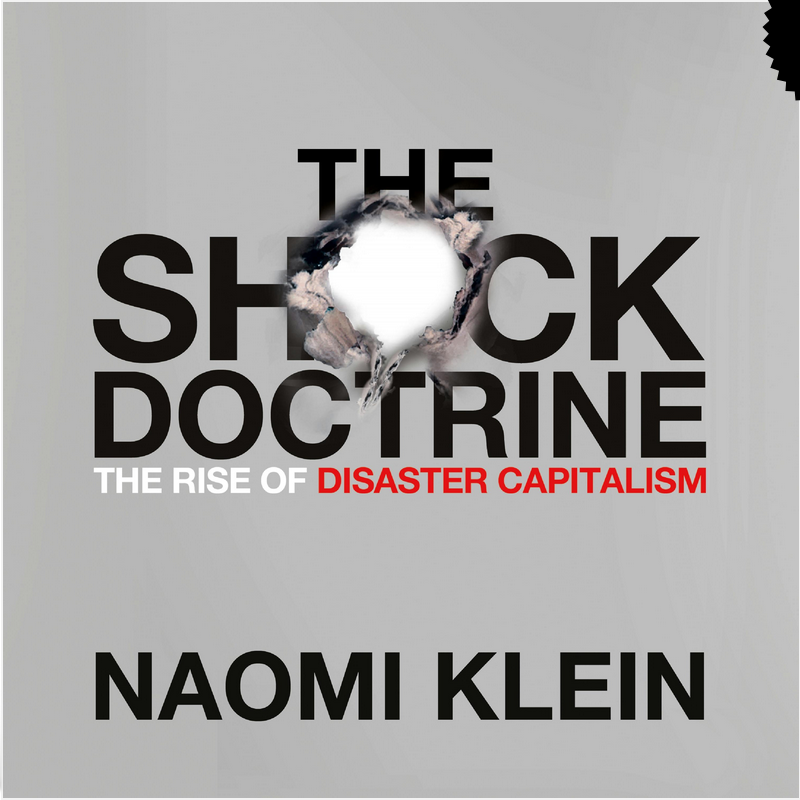
It’s main characteristics, she continues,
are huge transfers of public wealth to private hands, often accompanied by exploding debt, an ever-widening chasm between the dazzling rich and the disposable poor and an aggressive nationalization that justified bottomless spending on security. For those inside the bubble of extreme wealth created by such an arrangement, there can be no more profitable way to organize a society. But because of the the obvious drawbacks for the vast majority of the population outside the bubble , other feature of the corporatist state tend to include aggressive surveillance (once again, with government and large corporations trading favors and contracts), mass incarceration, shrinking civil liberties and often, though not always, torture.
The modern doctrine of privatizing state services en-mass, Naomi Klein, says, came from Milton Friedman. Often referred to as the Chicago school of economics, where he taught and where his proteges studied under him, his proposals of mass privatization have used natural and human-made disasters as catalysts to maximize private profit and minimize the need for state services. This has applied to Chile, Haiti, Syria, China, and numerous other places. It “came home,” Klein says, after September 11, 2001, and after Hurricane Katrina in 2003. There was a huge effort to get rid of public schools in Louisiana. Of course, the security state increased dramatically after September 11.
Milton Friedman had long-standing affiliations with some think-tanks calling for a neoliberal, or corporatist approach to government since the mid-1990s. Among those thinks thanks are the Cato Institute and the Heritage Foundation. The same Heritage Foundation that wrote Project 2025 – the playbook to privatize the government and attack civil liberties.
Twenty years later these policies are here to stay until we do something about it. The corporatist state has increased in strength, and has reached the point the rich live in a bubble and everyone else is disposable and a nuisance. That’s exactly why the current administration quickly revamped the US Digital Service to become the US Department of Efficiency, headed by the billion Elon Musk, and tasked it with “efficiently” overhauling the government and removing federal employees in an effort to quickly privatize essential services provided by the government.
It would be easy to blame the current administration, which as made the corporatist state obvious. Unfortunately but importantly, scholars, historians, and people continuing to pay attention, have pointed out that previous administrations have laid the groundwork for what’s happening.
Previous administrations, including the Democratic presidencies of Obama and Biden, also targeted non-white immigrants. A lot of attention has been given to ICE’s terrible policies of targeting non-white migrants for deportation. The detention of a Mahmoud Khalil, picked up for ICE because his political views has heightened that attention. The corporatist state is reaching the part where incarceration increases and civil liberties decrease.
How we respond will determine if we are governed by corporations or by people. We can’t have both.
 The Dole Blog