
Economic Non-Peace
Long before Hamas and other resistance movements penetrated Israel’s defense around Gaza last October Gaza was relegated to economic peace. Almost all commentary suggested that by failing to address the undermining political and economic realities that Palestinians face in Gaza and beyond Israel is entrenching the status quo of cycles of latent and physical violence.
WHAT IS ECONOMIC PEACE
Economic peace is the notion that if you give people economic opportunities other issues that might lead to conflict would be mitigated. Capitalistic to the core, and based on modern economics, economic peace suggests that if every one is well off – or has the opportunity to be well off – other issues, like land theft – will be bygones and two different cultures with two different histories and narratives won’t have further disputes. Economic peace is at best a fig-leaf designed to reject that other issues need to be addressed.
Professor of economics, Ibrahim Shikaki wrote about how economic peace only entrenches Palestinian reliance on Israel. He was writing just after another large scale attack on Gaza, in 2021. The international community responded, as usual, “by organizing a humanitarian mission for aid and reconstruction in the besieged Palestinian enclave” after the noticeable violence ended.
“Although a humanitarian response is sorely needed in Gaza,” Shikaki wrote, “failing to also address the political and economic realities Palestinians face will only entrench the untenable status quo of Israeli occupation and likely lead to further violence.”
Economic peace plans for Israel and Palestine are everywhere, Shikaki continued. Under Obama, Secretary of State John Kerry pushed his plan, and under the first Trump presidency the Kushner Plan promoted economic peace. (Links found in the Shikaki article in Foreign Affairs, but this information can be found elsewhere). Explaining how economic peace entrenches Palestinian reliance on international donors, Shikaki says that reports from the World Bank and the International Monetary Fund “calling for unhindered economic ties between the Palestinian and Israeli private sectors” are also economic peace plans. Economic peace, he says, is “a flawed theory that assumes there is an economic solution to a political problem” that suggests economic incentives will keep Palestinians from demanding their right to self-determination.
Shikaki is not alone in suggesting that economic peace is a flawed theory. Yossi Alpher, an Israeli security analyst, wrote in October 2024 that “Prior to October 7, 2023, Netanyahu thought he had a working strategy of buying off Hamas (“economic peace”) and deterring Hezbollah. He made no secret of this. It failed completely.” A year earlier, writing in December, 2023, Alpher summarized the still-fresh events of October saying that among Netanyahu’s “failed strategies for managing relations with the surrounding Arab world” was ‘economic peace’ – “it magically assumed that the Israeli-Palestinian conflict was economic in nature rather than territorial, ideological, historical and religious. We saw how economic peace worked on October 7.”
Alpher added that economic peace, specifically related to Hamas in Gaza, has been around for a long time. In 2009, a couple months of taking office yet again, Netanyahu called “on the Arab countries to co-operate with the Palestinians and with us to advance an economic peace.” More recently, following the Trump-era (Biden-supported) Abraham Accords, Netanyahu has collaborated with Qatar in hopes of advancing advancing economic peace in relation to Hamas.
HOW DOES ECONOMIC PEACE WORK
Shikaki, in his Foreign Affairs article, reminds us that “between 15 and 40 percent of the total Palestinian labor force worked in Israel at some point in the last 50 years and even more worked for the Israeli economy via subcontracting in the occupied Palestinian territories.” More than 1200,000 Palestinians from the West Bank or Gaza were working in Israel in 2022.
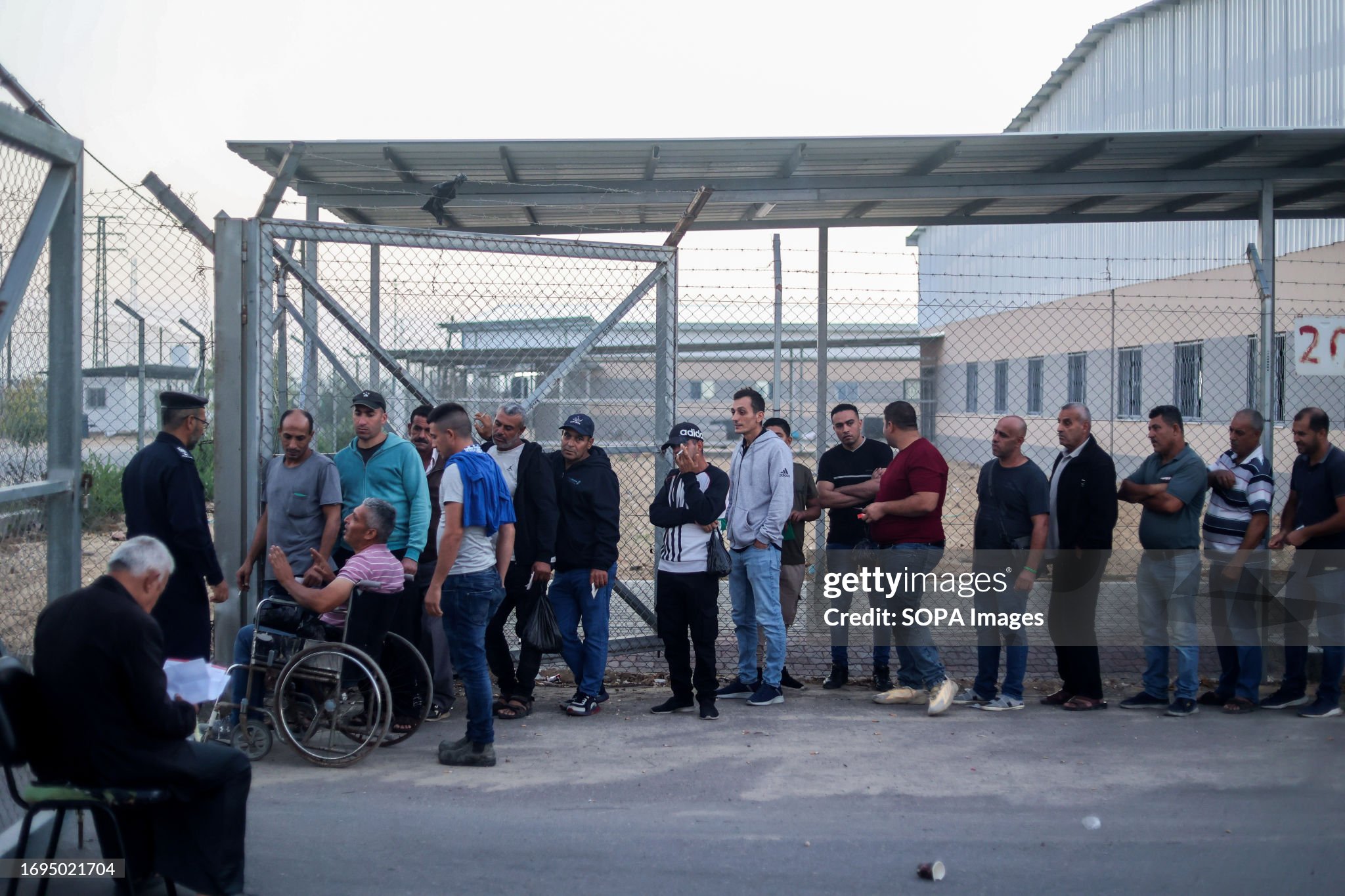
Shikaki continues, “the Israeli economy has made use of Palestinian labor to ensure low costs of production while opening Palestinian markets to its goods”. Shikaki says, “little has changed since the establishment of the Palestinian National Authority in 1994 through the Oslo peace process.” More workers, until October 2023, were working in Israel, but it provided an economic fig-leaf, not a durable solution to a political problem.
The whole process made Palestinians dependent on foreign investors and private debt, and Israelis somewhat reliable on cheap labor from Palestinians. NPR‘s “Israel’s war with Hamas disrupts Palestinian workers and Israeli employers alike,” said in November 2023 that “left without those [Palestinian] workers — and without alternative sources of labor, as Israeli reservists have been called to war and many foreign workers have fled the conflict — the construction industry in Israel is operating at 15% of its prewar capacity, according to the Israel Builders Association, an industry group.” Meanwhile the Palestinians in the West Bank, “the sudden shutoff of income has rippled through the economy, as workers struggle to pay their rent, car payments and children’s tuition.”
Somehow this doesn’t sound like it leads to peace.
 The Dole Blog