
One Man’s Terrorist: Hamas Version
Growing up, there was a sort of junk yard where you could pick through discarded metal and other light machinery other people had given up on.
It was called something like “One Man’s Treasure,” meaning that someone’s junk could be useful to someone else. Of course, one man’s terrorist is another person’s freedom fighter.
To the Western governments with a history of colonizing, or being colonized, Hamas is one man’s terrorist.
Padraig O’Malley, in the Two State Delusion (2015), provides the following succinct summary of the beginning of Hamas, and he also shares in his book work that Israel and Palestine (including Hamas in Gaza) are addicted to the “peace process” and need each other to continue the charade of the process. Hamas was created by Sheikh Ahmed Yassin, and other friends. Years before this, in 1970, Yassin was “allowed” by Israel to register an Islamist charity group called Mujama al-Islamiya. The group refrained from violence but clashed with the PLO, which they saw as a rival. Hamas was formed in 1987, during the First Intifada, which started as a nonviolent protest against Israeli policies,. It wasn’t until 1992 that Harakat al-Muqawana al-Islamiya, or Hamas, added a military component to their composition. Avi Shaim, in The Iron Wall, adds that not only was Hamas created as a result of the Firs Intifada, but Israel encouraged it’s creation in the hope of weakening the secular nationalism of the PLO.
It should be common knowledge, although it becoming increasing clear that it isn’t, and that legislators and policy-makers in Washing D.C. either don’t know or won’t recall, that Hamas was elected to represent Palestinians in 2006. The election, which was promoted by the United States – and monitored by Jimmy Carter, who wrote about it Peace: Not Apartheid – was a free and fair election in which Hamas received a narrow popular majority but a a clear majority of parliamentary seats (74of 132). Hamas was interested in forming a unity government with Fatah, Jimmy Carter later wrote, but Abbas’ intention “was not cooperate with them”
Jimmy Carter, in his talks with Hamas leaders leading up to the election, says that Dr. Mahmoud Ramahi, who would be elected a parliamentarian, and then imprisoned by Israel, told him that Hamas hadn’t committed an act of violence since the ceasefire in August 2004, and that they were able and willing to extend the ceasefire (hudna) for ‘two, ten, or fifty years’ if “Israel would reciprocate by refraining from attacks on Palestinians. In 2006, elected Hamas prime minister stated that ‘we have no problem with a sovereign Palestinian state over all our lands within the 1967 borders, living in calm.’
Following the October 2012 Operation Pillar of Defense, as Israel called it, Hamas maintained a ceasefire. Further, prior to the Operation Protective Edge of 2014, Hamas and Fatah forged terms for a unity government. The U.S. approved but Israel was furious because this uncut Israel’s claim it can’t negotiate with a divided Palestine, Noam Chomsky wrote, in On Palestine. The unity government accepted three conditions the United States and the European Union have long asked for: nonviolence, adherence to past agreements, and the recognition of Israel.
Referring to the 2008-09 Operation Cast Lead attack on Gaza, Chomsky, in Gaza in Crisis, quotes Thomas Freedman in Gaza in Crisis saying that Israel’s tactics of attacking civilians during the war was meant to ‘educate Hamas’. In that Operation, like many others, Israel attacked civilian locations like police stations, villages, homes, densely populated refugee camps, water and sewage systems, hospitals, schools and universities, mosques, UN relief facilities, ambulances “and indeed anything that might relieve the pain of the unworthy victims”.
With some revisions, including fixing some typos I made in haste and exhaustion, I handed the above summary of the formation of, history of,, and policy of, Hamas to my Congresswoman in a meeting I had about two weeks ago. The meeting, planned months in advance, naturally ended up focusing on ceasefire – a resolution she still hasn’t signed on to and very Representatives have endorsed – and other Palestinian rights issues. It was expected, though, that there would be talks of Hamas, and it became clear she knew nothing about the history of Hamas, like it’s endorsement of a two-state solution – a solution that almost every member of Congress mentions, without contemplating how it could happen given actual facts.
What’s written above isn’t a full history of the history Hamas, but rather an attempt to summarize what other say, and therefore what we should know, about some of the basics about Hamas.
During his time as Special Rapporteur on the situation of human rights in the Palestinian territories occupied since 1967, Richard Falk wrote extensively about Hamas. In 2013 he wrote, in an article about how Israel fragments Palestinian lives and tries to drive a wedge between their social and political lives:
Israel and its supporters have been able to drive an ideological wedge between the Palestinians enduring occupation since 1967. With an initial effort to discredit the Palestine Liberation Organization that had achieved control over a unified and robust Palestine national movement, Israel actually encouraged the initial emergence of Hamas as a radical and fragmenting alternative to the PLO when it was founded in the course of the First Intifada. Israel of course later strongly repudiated Hamas when it began to carry armed struggle to pre-1967 Israel, most notoriously engaging in suicide bombings in Israel that involved indiscriminate attacks on civilians, a tactic repudiated in recent years.
Despite Hamas entering into the political life of occupied Palestine with American, and winning an internationally supervised election in 2006, and taking control of Gaza in 2007, it has continued to be categorized as ‘a terrorist organization’ that is given no international status. This terrorist designation is also relied upon to impose a blockade on Gaza that is a flagrant form of collective punishment in direct violation of Article 33 of the Fourth Geneva Convention. The Palestine Authority centered in Ramallah has also, despite occasional rhetoric to the contrary, refused to treat Hamas as a legitimate governing authority or to allow Hamas to operate as a legitimate political presence in the West Bank and Jerusalem or to insist on the inclusion of Hamas in international negotiations addressing the future of the Palestinian people. This refusal has persisted despite the more conciliatory tone of Hamas since 2009 when its leader, Khaled Meshaal, announced a shift in the organization’s goals: an acceptance of Israel as a state beside Palestine as a state provided a full withdrawal to 1967 borders and implementation of the right of return for refugees, and a discontinuation by Hamas of a movement based on armed struggle. Mashel also gave further reassurances of moderation by an indication that earlier goals of liberating the whole of historic Palestine, as proclaimed in its Charter, were a matter of history that was no longer descriptive of its political program.
Falk concludes his book, Palestine: The Legitimacy of Hope, by writing about the imprisoned nonviolent resistor Marwan Barghouti, saying, “I believe that when Israel is ready for a sustainable and just peace it will signal this to itself, to the Palestinians, and to the world by releasing Barghouti from prison and by treating Hamas as a political actor with genuine grievances and aspirations that needs to be included in any diplomacy of accommodation that deserves the label of ‘peace process.’”
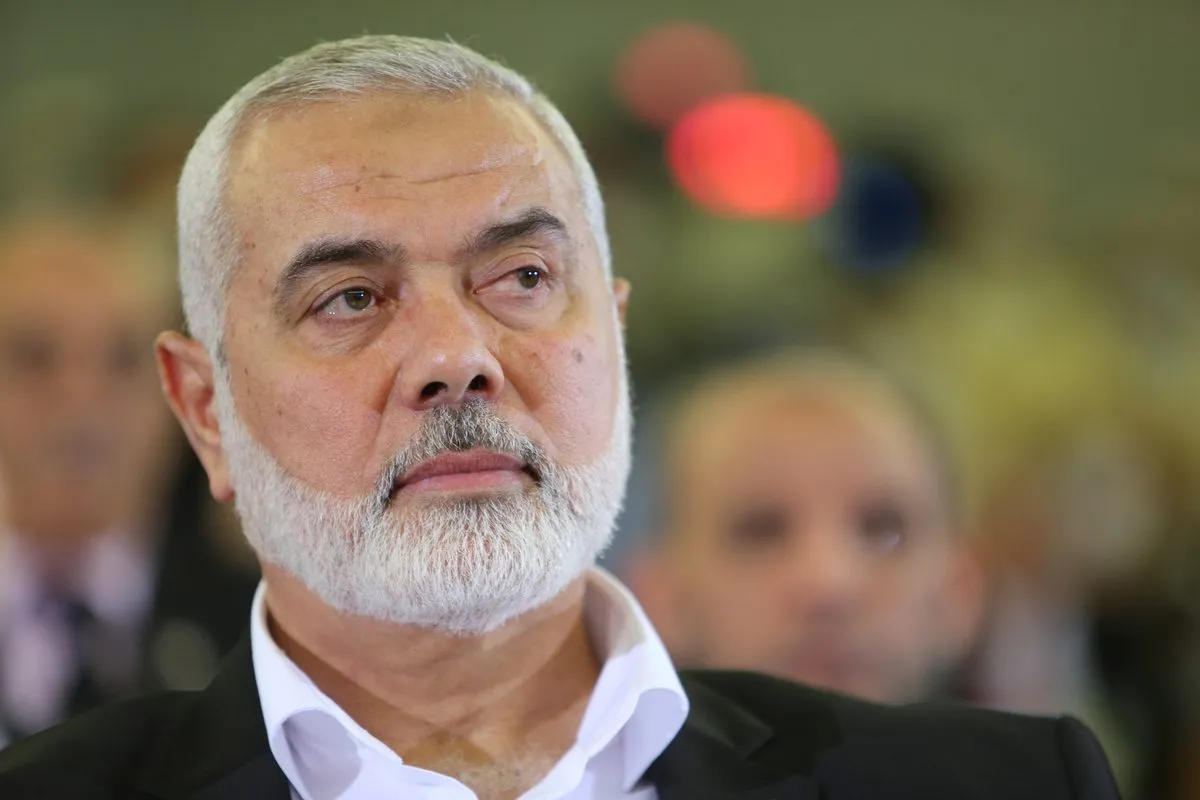
Ismail Haniyeh Head of the Hamas Political Bureau on October 13, 2022 [Fazil Abd Erahim/Anadolu Agency] from https://www.middleeastmonitor.com/20231124-hamas-leader-haniyeh-confirms-their-commitment-to-humanitarian-pause/
 The Dole Blog